
 Posts


Saturday came the rains, Sunday the confused seas, but by Monday the wind and seas calmed sufficiently for me to jump overboard and clear the tangled fishing line from the port propeller. The boat dipped and rose in the 8 foot swells, but the lack of wind waves atop the swells made it possible for me, tethered to the boat with a harness, to swim underneath the hull and cut the line free. It took about 30 minutes, with repeated dives to avoid being clonked on the head by the hull or engine. This is the third time we've inadvertently run over our own fishing line, and as Jennifer pointed out, "We just don't get it, do we?" We're working on a checklist approach to reefing that has, as Steps 1 through 5, "Bring in the fishing lines." In the interim, as a kind of self-imposed punishment, I'm no longer fishing.
That day, on our reassuring daily radio net with our friends on Second Wind and Pylades, we heard the forecast for the next few days, courtesy of Second Wind and its owner's son's regular weather updates from his Stateside location. I quote: "Tuesday afternoon - large choppy seas, winds ESE at 21-28 knots." You could have set your instruments and clocks by this bit of news. The next day, at noon, the winds picked up to the high 20s, and the seas moved from the rinse cycle to the spin cycle. Coming from every which way, east to southwest, the seas loomed higher by the hour as they combined their crests and troughs; we quickly reduced sail so that we were at the prescribed configuration: a triple-reefed main, and a 30% genoa. We began to skim over the wave tops, with a cresting wave every few minutes dowsing our cabin top with hundreds of gallons of sea water, or slapping our topsides with a bang and a crash.
The forecast indicated a gradual organizing of the swell pattern, even as the wave heights were projected to increase to 4.5 meters ... this is the distance from trough to peak, so, visually and viscerally, we were looking at - and sailing across - 30 foot walls of moving ocean, a relentless rippling of energy. Jennifer and I have each experienced these kinds of seas, but only on a monohull, with its heavily-weighted keel serving as a righting moment when the seas threaten to lay the boat on its side, and every additional degree of heel diminishing the sail area presented to the wind. Together, these forces -- the weight below the boat, with its righting force increasing as the boat heels (think about those tall blow-up punching toys you might have used as a kid, that are weighted on the bottom, and how they always -- improbably -- come up for another punch), combined with the disappearing sail area, as the sail approaches the horizontal - create a very stable platform for sailing - willows in the wind as it were, bending but breaking. In fact, there are hundreds of well-documented and even filmed cases where a monohull is "knocked down," laid flat onto the sea, and, relying on the force of gravity, as the keel seeks equilibrium, the boat lifts back up, however groggily, not too worse for the wear. Not something to seek out, to be sure, but I'm just saying ∑
Neither of us has had much catamaran experience in these wind and sea conditions, although, Lord knows, we've read enough accounts and heard enough stories to know that the one thing to avoid is to have too much sail up, since there is no forgiveness on a cat. More oak than willow, cats either sail upright or lay fatally awash in the seas. Without a deep keel, with its underwater counterweight (tons of lead in most monohulls), a wayward gust or wave can push the cat sideways to a tipping point of no return, and just like that, the trip is over. Against this factual background, we became a bit anxious as we gauged the response of now-triple-reefed ile de Grace to the large and choppy seas and brisk winds coming across our port beam. We reassured ourselves that we were sailing her by the book, with the sails at their recommended settings, designed to balance safety with speed.
And fly along we did, although the pitching and yawing of our rectangular floating raft was sometimes fearsome to behold. We are accustomed to relatively level surfaces when we sail our boat; its design promotes this, with two hulls astride a central platform. I can't remember a time when a coffee cup, placed on our cabin table, wouldn't still be there hours later, even in some of our roughest seas. For the most part, the wind and sea conditions on that Tuesday permitted this kind of casual placement, something inconceivable to monohull sailors whose boats, in these kinds of conditions, sail at a perpetual 30-50 degree angle to level. On their boats, every movement is an exercise in leveraged motion, and each utensil, book, and dish is wedged or secured against an often-elaborate arrangement of positioning and locking devices.
But by nightfall, with the seas continuing to gather strength and the winds picking up to the high 20s and low 30s, the normally serene interior of ile de Grace resembled that of our monohull sisters, with cups and dishes stowed away, and the usually-level interior surfaces emptied of anything that might slide. We found ourselves moving from handhold to handhold in the cabin - going outside was neither necessary (given our interior instrumentation and 360 degree visibility) nor especially enjoyable. Our monohull friends will smile perhaps incredulously as they read our surprise at having to hold on while moving about, but truth be told, it's an uncommon experience for a cat owner.
Catamarans also differ from monohulls in their reaction to crossing waves, waves that approach from the side. While both kinds of boats are vulnerable to the "sideslap," when a cresting wave slams against the side of the hull, a catamaran is also vulnerable to the "underslap-innerslap combo," as the wave passes underneath one hull, slams against the bottom of the bridging cabin, and then, as often as not, slams against the inside of the downswell hull before passing underneath and into the distance. The seas on Tuesday were sufficiently disorganized and large that we were experiencing the characteristic "combo" every few minutes or so. For those not used to it, the sound and sensation leads one to conclude that the boat has just struck a large and immoveable submerged object ... a sensation that is extremely disconcerting even if you know it's "normal."
Through that night, into Wednesday morning, both Jennifer and I harbored a growing fear that sailing "by the book" might, in fact, be too aggressive for these particular sea conditions. As we heeled downswell and downwind, sliding down a swell, our stomachs would occasionally churn, our muscles tense involuntarily, as we waited to feel the boat right itself. Combo slaps became the rule. I should note that the shallow design of cats in fact can work to its favor in these conditions, as they tend to slip and slide across and down the wave, unable to grip or pivot. It's a surfboard without a fin.
Were cats to have deeper keels, the hulls would, in fact, lock into the water, with the topsides and sails then able to tumble sideways, leading to a knockdown, from which cats, unlike monos, cannot survive. For monohulls, the keels do lock in, but the combination of weight and reduced sail away inhibit the tendency to be knocked down, and even if knocked down, monos will right themselves. For cats, they'd rather slide than tip, for the most part. Using a car analogy, monohulls resemble Subaru Outbacks, and cats are more like Ford Expeditions; both have four-wheel drive and purport to handle slippery conditions, but the driving experiences are extremely different.
Given this slipping tendency, we were not without intellectual recourse as we sought to calm ourselves during the evening's more gut-wrenching slides and slaps, and the accompanying sensations of heeling over uncontrollably. However, it's fair to say that in these kinds of situations, the limbic system takes precedence over any kind of intellectualization, and we spent the night in a state of palpable concern.
So through the night we fretted, and through the night we raced down and across invisible seas, making excellent time to our still-distant destination of Mauritius. There's a spirited debate among ocean sailors whether sailing through rough weather is scarier at night, when you can't see the approaching waves, or in the day, when their size and occasional fury is all too evident. I come down squarely on neither side of the debate, and would rather sail in calm seas, all things being equal. By mid-morning, after our daily check-in with our sailing companions, we decided that discretion was the better part of valor, and while heartened by our significant progress over the previous 24 hours, we doused the mainsail completely.
This required us to turn the boat into the wind, using our engines, and reducing our speed to a crawl, just enough to keep the boat pointed into the wind. The loss of forward movement allowed us to appreciate the magnitude of the seas around us ... standing atop our cabin, ready to furl the main, my eyes were a good 15 feet above the water line as each successive swell approached, and our boat lay in the windless lee of the trough, I would lift my eyes sharply and see a near-vertical 30 foot wall of water moving toward us. Just as it felt we wouldn't make it over, our boat would rise up the leading edge of the swell, pause briefly on its crest, and then slide gently down its backside. As the boat hung atop each passing peak, I could see all around me swell upon swell, a sweeping procession of triangular ridges, one after the other, south to north, carriers of invisible energy and unimaginable volumes of clear deep blue water.
Experience allowed me to appreciate the seeming contradiction between the almost-serene motion of these swells, and their awesome embedded power, strong enough, in the "right" conditions, to take a multi-ton boat or ship and slap it silly, drive it down, and turn it upside down. I knew these swells were more talk than action, lacking as they did any serious cresting waves. As surfers and sailors know, the water doesn't really move as the swell passes ... a cork will remain relatively stationary as the swell passes underneath. Thus, swells without cresting waves pose little danger to a well-designed boat, be it sail or power, monohull or catamaran. On the other hand, if the waves are cresting, the swell propels a wall of moving water that can drown surfers or capsize even the sturdiest vessel. These were large swells, but, in their essence, harmless. Not the grizzlies of the far southern oceans, whose dangerous wind-swept cresting seas blow horizontal plumes of smoke-like sea water across the decks of ships and boats foolish or brave enough to sail those waters. These were more like circus bears, large and capable of mischief, but usually harmless. Usually.
We are happy to have dropped the main, proceeding, as we have for the last 24 hours, on a tiny scarf of a genoa. Our speed over ground has dropped a bit, so we'll be at sea a bit longer than if we had continued to tempt fate, the seas, and our constitutions, but it's not a race. We slept easier last night, and in a drowsy state of almost wakefulness, I thought I heard our tiny boat whispering "Bless you - I was getting tired of all that slapping" ... or was that Jennifer ... or was that me giving thanks?
Thursday, September 22, 2011

Tuesday, September 20, 2011
Memory -- Indian Ocean Passage -- Part 1
We left Cocos Keeling around lunchtime on a Thursday, a leisurely morning spent mailing a package containing the now-replaced watermaker pump back to the dealer in Brisbane and some last minute internet connections. The sky was clear, the water turquoise, and we weighed anchor at the same time as our Irish friends, Fergus and Kay, slipped their anchor on their hand-built 39 foot steel sloop Pylades. The Alaskan boat, Second Wind, would soon follow after some last minute repairs to their autopilot. We eased out of the coral lagoon, raised sails, and turned north and then west to Mauritius, 2300 nautical miles across the Indian Ocean. The winds were less than we expected, as were the seas, and we debated increasing our sail area to maximize our speed, but decided to leave things be, against the possibility of winds freshening.
By evening, with Pylades well ahead of us, and Second Wind passing us to port, we re-considered our sail deployment, and shook a reef out of the wind, accelerating slightly in the evening breeze as a full moon rose behind us into a clear, star-filled sky. A delightfully low-key beginning to our longest two-person passage yet. Earlier in our circumnavigation, we had sailed the 3000 or so miles from Galapagos to the Marquesas, but then we had the pleasure of my brother Stephen and his wife Guita for company. No matter how much sailing you've done, passages take a toll on the mind and body, and the toll is eased with additional crew to share the watches and provide each other company and respite from the relentless wind, wave, and sky. Having a quiet first night on this long two-person passage was a blessing. The following day - Friday -- was more of the same: light winds, calm seas, and gentle sailing.
On Friday night, I had my normal 10pm to 2am watch, and, as is our custom, turned the radar on every half hour or so to check for ships and approaching weather. Our boat is equipped with something called AIS - Automatic Identification System - which receives location and course/speed information from transmitting vessels, said vessels to include, by maritime law, all cargo ships over a minimum length. Unfortunately, we discovered in Indonesia that many Indonesian vessels had yet to comply with the law, so we've gotten into the habit of trusting our AIS but verifying with our radar. That night, I was surprised to see a few rain clouds off to the southwest, headed our way. As readers may recall, rain has been a rare visitor to ile de Grace these past months, so I welcomed the short spritz of rain that evening.
For me, passages are something between a leap of faith into an unknown ocean, with unknown weather and sea conditions, and a competing belief that we'll just pick up where we left off on the prior passage, sailing in the same weather and sea conditions of the just-completed passage, no matter the interlude between the two passages. I suppose it's a reflection of my short attention span but I somehow assume, emotionally, that the wind, wave, and weather patterns of the prior passage will simply re-materialize on the current passage, even as I know, logically, that this is at best unlikely. It's as if my memory holds time in abeyance during the period my boat is in port - as if somehow the sea and sky outside the refuge go into freeze frame, unable to click to a new screen. Hence the decision to leave Cocos under-canvassed - after all, we came into this lovely atoll in stiff winds and strong seas, and surely, the weather would not have eased in the interim, would it?
Satuday morning, after the evening shower, I awoke to my 6am-10am watch and saw banks of clouds across the south and western horizons, and soon, the clouds darkened, swollen with rain and scuttling toward us, a harbinger of a windy and squally day. The winds began to pick up, from their 10-15 knot range of the prior day to 15-20 knots, and then, accompanied by driving rain, to 20-25 knots. We decided to practice a maneuver known as 'heaving-to,' whereby the sails and rudder of a boat are arranged so as to result in the boat bobbing quietly in the gathering seas, moving ever so gradually backward in the water so as to leave a smooth slick of water between the boat and the oncoming waves. It's the safest way to ride out heavy weather, and the combination of sail and rudder is different for each boat, so, with over 2000 rugged miles of ocean ahead of us, we thought it'd be good to practice. To our chagrin, we had another of those moments where the golfing practice of "mulligans" would have come in handy; we left our fishing line out, and, inevitably, it wrapped around our prop, leaving us reluctant to use the engines until we sorted things out down there. Of course the very conditions that led us to try the heaving-to maneuver, and, in our thoughtless haste, the line wrapping maneuver - gathering winds and seas - made it just about impossible for me to jump over the side and cut the line free. So we cut short our practice session, dropped our main to reflect winds that were now blowing 25-30 knots, and turned back on course.
For the rest of the day, we huddled inside, sheltered from the driving wind and rain. The seas were building steadily, and soon we were sliding up and down and across 12-15 foot waves, trough to peak. Our salon is surrounded by windows - too large to call portholes - and I was again able to see one of my favorite sights as the rain fell hard on a wind-whipped ocean. Between the squalls, with swells moving every which way, the wind-generated waves on top of the ocean create a mosaic of white foam tips, and wave peaks and curls, a swirling mass of sharp upward-jutting edges punctuating the surface of the undulating ocean. When the rains come, the force of the droplets tends to flatten these tips, peaks and curls, and the surface of the sea takes on a velvety sheen, resembling a vast billowing piece of sand-etched glass, an outsized version of those green and blue pieces of weathered glass my beachcombing grandmother would collect and glue carefully to glass globes in her Florida condo. I love watching the gusts pass over the waves, flattened as they are by the rain, and seeing the wind pressing down on the matte-grey water, its gusts visible as shifting gradations of texture on the silky pockmarked surface. It's a nice way to pass time on a rainy Saturday at sea.
The swell patterns in this part of the Indian Ocean are a far cry from well-ordered. On prior passages, in the Pacific especially, the trade wind-driven swell patterns produce sets of reasonably well-ordered waves that follow one after another, a vast corrugated ripple moving in synch, toward the west-north west, across a blue ocean. Here, a succession of west-to-east moving deep low pressure systems in the deep southern latitudes - the Roaring Forties, between the southern tips of the continents and Antarctica - create a pulsing set of swells moving northeastward into the waters of the southern Indian Ocean. These swell patterns build over several thousands of miles until they cross, at right angles, the northwestward moving swells driven by the SE trade winds. The result, experienced by sailors going back into the earliest days of sea travel, is a mightily confused ocean, with northeast-running swells colliding continuously with northwest-running swells. It's as if the ocean at these latitudes reflects the present tense of its immediate weather, the trades, and the lingering memory of its southerly weather, the lows of the Roaring Forties. Unlike this poor sailor, the ocean seems not to be challenged by living in the present, even as it remembers the past.
By today, Sunday, the squall-laden front has passed us by to the west and north, but the strong winds persist, as do the confused seas. It's been a day of boat body slams, as one swell grabs our stern and another slams our beam, and then one grabs our beam while the other slams our stern. For us, a catamaran headed west-southwest, these conditions are especially annoying, since our broad beam and dual hulls catch the northeastern swells square on, while the north westward running swells swing our generous stern back and forth like a car skidding down an icy hill. We swing left and right, even as we roll back and forth, and the resulting corkscrewing motion is tolerable but tiring.
As a result of these conditions, we've reduced sail considerably, since the last thing we want is an untoward combination of a swell and a gust turning us onto our side. Unlike monohulls, whose deep lead-heavy keels provide a righting moment to return a flattened hull to its upright position, the catamaran is designed to either float right-side up or upside down - heeling is not part of its repertoire. So in deference to our design, we have only a reefed Genoa out, and the boat is being pushed along (or pulled, as it were) at about 5.5 knots, a tidy pace but one unlikely to approach the 7.5 knot average we enjoyed on our passage to Cocos from Bali. Over a 2300 mile passage, the difference between the two averages is the difference between a 17.5 day passage and a 12.7 day passage. With more orderly seas, we could have more sail out, and a corresponding increase in speed.
One's mental outlook on sailing can be tipped crucially in the face of a passage that suddenly seems to have sprouted an extra 5 or so days. Despite the oft-described glamor or adventure of ocean sailing, I have moments when I consider the time at sea to be somehow wasted; days flow into nights into days, and the meditative repetitiveness I described in an earlier blog can also resemble a mechanical monotony of waking and sleeping, an oscillating state of mindless motion. In fact, one cruising adage describes sailing as periods of excruciating boredom punctuated by moments of sheer terror.
Neither bored nor terrorized, the disconnect between my expectations of a repeat of the fast Bali-Cocos passage, and the actual sea conditions has nonetheless caused a measure of discomfort in my soul, one entirely of my own making as my memory tricked me into a false expectation. We expected a fast, smooth passage, but the ocean has another plan. Our logical minds understand that we can only control the sails, and not the weather, but our spirits lag in their adjustment to the sea-level realities. I'm slow and reluctant to adjust expectations, wishing against experience that the confused seas will organize themselves, permitting a more aggressive sailing posture.
So that's the other side of a passage - the leap of faith and the need to recalibrate expectations when the new passage's conditions do not, in fact, correspond with the prior passage's conditions. We're out here, three days into the trip, assimilating the likelihood that this trip will surely take longer than we had hoped for, and in fact, shame on us, than we had expected. I'll get over it, if only because I have to: reality always wins. But it's caused me to reflect on the role of memory in generating expectations. I have a short attention span, so I expect tomorrow to look like yesterday. But the ocean has its own way of marrying the past with the present, into the future we'll face tomorrow, and, out of sight and out of mind from a pair of sailors spending a quiet week in a picturesque coral atoll, the sea made its own plans for our wind and sea conditions. The lows in the Roaring Forties continued to develop, deepen, and roll eastward. The swell patterns moved north, and the seas here remain confused. Our memories are short; the sea never forgets. Something to remember.
Wednesday, September 14, 2011
Departing Cocos Keeling
It's Thursday morning here in the eastern end of the Indian Ocean. Jon and I have topped off the fuel, refilled our water tanks (thanks to a repaired water maker), and re-provisioned. After a final dinner and drinks with fellow cruisers on the beach, accompanied by music and a coconut fire, we are ready to head for Mauritius.
It will be a 2300 nautical mile passage and we're departing with two other boats, Pylades from Ireland and Second Wind from Juneau, Alaska. It's good to have company and someone within radio distance so we won't be alone out there. We expect the passage to take around 16 days, and you can track our progress using one of the links on the left hand side of the page.
Fair winds, Jon and Jennifer
Monday, September 12, 2011
Dry Season
 |
| Direction Island, Cocos Keeling, Australia |
Years ago, Jennifer’s dad told me a Texas joke about rain
that goes something like this: “An
old farmer stands with his son on his porch, gazing longingly at a distant dark cloud approaching his farm. He
turns to his visiting cousin, and says:
“I wish it would rain … not so much for me -- I’ve seen it rain -- but for
my boy here …”
It’s been like that for ile
de Grace these past months:
bone dry days and nights in the eponymous dry season. When we left Cairns, Australia in late
May, we had already entered the austral dry season, and had not seen rain for
weeks. Sailing up the Queensland
coast, inside the Great Barrier Reef – no rain. On our trip to the Spice Islands, we arrived in a brief
shower as a low pressure trough meandered its way across the volcanic islands,
spilling what little moisture it had stored up. That was June 22.
Since then, throughout Indonesia – no rain, no drizzle, no sprinkles, no
nothing. It’s September 10 here in
Cocos Keeling, Jennifer’s birthday, and we haven’t even seen a dark cloud since
that June day … and before that, it was late April. One brief rain shower in nearly five months.
 |
| Our first rain since June 22 ... |
So when we spotted the dark clouds on the southeastern
horizon this afternoon, it took a moment to register – was that rain? Could it be? Soon enough, we saw the line of rain spattering the surface
of the protected waters inside the reef, headed our way, and quickly, a cold
rain began to pelt down, washing away the boat’s accumulated salt of our recent
7 day passage from Bali, providing a much-needed fresh water rinse for ile de Grace.
Fresh water is scarce in most of the tropical waters for at
least half the year. Indonesia,
like most tropical countries, lies parched for rain half the year, and then
desperate for dryness the other half. As we sailed along the northern edge of
Nusa Tengarra’s islands, the hillsides were parched brown, a far cry from the
lushness of the wet season. No
surprise, of course, since it’s our choice, as sailors, to favor the dry
seasons, as the winds tend to come from the southeast, perfect for our
west-about circumnavigation. Once the winds swing around to the southwest, wet
season arrives. Several centuries
ago, the coastal nations of the Indian Ocean used this semi-annual swing of the
winds to trade with one another, heading west in the dry season, and east in
the wet season, moving spices and textiles between the Asian and African
continents. The old trading ships
cared more about cargo than rainclouds, and sailed in the wet season, but truth
be told, we prefer dry sailing to wet sailing, hence our westabout
circumnavigation. However, after
five months of dryness, enough is enough, and the rain fell, as they say, like
manna from heaven. Clear skies are
great, but all things in moderation – including perfect weather.
Thursday, September 8, 2011
Fingertips
One of the hidden treasures - in truth, aside from our fellow cruisers, the only treasure, hidden or otherwise - of Bali Marina was a well-stocked book swap room, with over 500 books piled on shelves and in boxes, left by passing sailors who had run out of room for already-read books. The swap at Bali Marina was started by my new friend, Bobby Friedman, who captains a large sailboat that's often based in the marina. (His entertaining and pungent blog, recommended reading, is here. I spent a morning inside the tiny swap room, arranging the books, perusing the titles, and re-stocking ile de Grace's library, as well as donating our already-read books that had been collecting mold on our shelves. With the exorbitant price of books in Australia ($25 for a paperback!), the bookless ports of eastern Indonesia, the untimely drowning of my Kindle, and my forced 3-week laying-in while Jennifer returned home, the tiny room and its book collection proved to be my salvation. Kudos to Bobby for starting something special.
The accidental discovery of new authors, courtesy of the cruising lifestyle's reliance on these book swaps, has been an unanticipated benefit of our trip. Boats being tight on space, few sailors keep books they've read, choosing instead to exchange them at ports of call. Across the Pacific, book swaps occurred wherever cruisers congregated. In Tahiti, the books were piled up in the laundry room; on Rarotonga, at the nicest restaurant on the island. Your faithful correspondent has a nose for these places, and each time we stopped, Jennifer would plead with me to choose only the least-moldy books. As she points out, on a boat, what doesn't rust, molds, so to be fair, it's a real concern. I've managed to "discover" such disparate authors as David Mitchell, Ian Rankin, and Tim Winton, among others, and I'm in debt to those cruisers who have left those authors' books behind for others to enjoy.
The books at the Bali Marina tended to the mystery and thriller genres, although there was a Bible or two, some how-to sailing books (!), and a number of classic novels and non-fiction works. About one-third of the books were non-English - a heavy dose of German, some French, and a few Spanish. Patricia Cornwall's forensic detective novels seem to enjoy a wide international audience. In leafing through some of them, I was reminded of another cruising tradition - scribing books with the name and home port of the donating boat, along with the occasional note indicating which port the book had been picked up in. Reading these notations reminded me that books have lives of their own, often traveling from town to town, country to country, or, in this case, port to port, leaving a wake of readers in their path. Some of the Bali books had most recently been in South Africa, where we are headed; others, in Australia, Fiji, or Galapagos. It's an arresting image, this one of books migrating across oceans.
With Jennifer gone, and me resigned to keeping the boat safe and secure, the Bali books helped me pass the time. When Jennifer returned back from the states, in addition to replacing my Kindle, she also brought with her some books generously shared by some friends of ours in Austin, Texas. One of them, The Shadow of the Wind, by the Spanish author Carlos Ruiz Zafon, centers on the life of a book, and begins with a visit to "the Cemetery of Forgotten Books." The Cemetery houses "books that are lost in time," and is a place where they "live forever, waiting for the day when they will reach a new reader's hands." As Zafon's character relates, "in truth, books have no owners."
I happen to collect books and can attest to the assertion that books have no owners; I'm loathe to throw any book out, preferring instead to donate it to a library, sell it to a used book store, or give it to a friend - I don't feel as if I own a book, only that I am a custodian. Like Bobby, I've created a book swap or two with my excess volumes, and I imagine these book swaps attracting other donations and living on for months and years to come. I've come to realize that there's a reader for every book, and a surprise in every collection. The Zafon book is case in point -- a mesmerizing book of passions, centered on books, with each chapter answering one question in the unfolding mystery, and posing two more - creating a momentum and urgency that's addictive.
Having fallen asleep reading, I woke from my midday nap (with alternating 4 hour watches, you sleep when you can) with an image of fingertips touching books, and of readers connecting to one another through the physical act of touching the same book, even if separated in space and time. In this, the Kindle, for all its obvious benefits to a space-constrained reader, cannot hope to compete. There is something magical about touching a book that others have read and others will read ∑ to me, books create a palpable sense of connection between readers, especially if the readers share the same physical book.
And so this, written as we sail briskly on a broad reach, under a bright sky across a blue Indian Ocean:
Fingertips
From time to time, I pull down the book
You gave me the afternoon before I left,
And examine the paper on each page,
Recalling that your fingertips once rested
Here, and here, leaving a patina of memory
That I now touch, tip to tip, print to print,
As if by pressing against the paper,
I can pull your hand away from this book,
Like a glove lifting off the page, sliding back,
Your skin wrapping around my fingers, my wrist,
So that once again we might read these words together.
Saturday, September 3, 2011
Humidity
On certain windless nights, like this one, the small weather station on the corner of our navigator's table indicates a humidity level approaching 100 percent. The air temperature in the cooler Indian Ocean is a seemingly-chilly 77 degrees, and at these lower temperatures, it doesn't take much to saturate the air hovering above the gently undulating pale green waters of this new ocean. It's our first time in - or, more accurately, on - the Indian Ocean, and our first day began with a gentle casting off from the concrete docks of Bali Marina, a morning glide out of the harbor and then the turn to the west-southwest, towards Cocos Keeling, Mauritius, and South Africa. The water temperature careened wildly between 72 and 82 degrees as we passed through upwellings associated with the strong south-setting current carrying water from the north side of the Indonesian archipelago to the Indian Ocean on its southern shores. The southern tip of Bali - far removed by distance and an isthmus from the tourist-laden streets and alleyways of Kuta, Sanur, and Denpasar - lay to our starboard, cliffs that are slowly being excavated and buttressed to support yet-more villas, hotels, and condominiums.
On these kinds of nights, with the decks and cushions saturated with salty dew, it's not that comfortable to sit outside - the dampness, and the chilly air, keep me inside the cabin where, in the intimacy of a boat and an ocean, the humidity is still high enough to leave the wooden floors slick with a thin layer of moisture. It's Friday, and we're headed west toward a setting waxing moon, motoring across a windless ocean. I had hoped it wouldn't be like this; the weather forecasts indicated winds from the east-southeast at about 15-20 knots, conditions that are perfect for our genaker, a large, light sail that pulls the boat nicely along in those kind of following winds. Instead, except for a brief period of southerly winds where our genaker-mainsail combination propelled us along at 6-7 knots, we've had nothing more than a whisper of wind from the southeast. One of the occupational hazards of tropical sailing is that the sub-tropical tradewinds sometimes die out near the equator, a victim of the competing offsetting coriolis forces that also prevent hurricanes from crossing the equator. I'm glad we have full fuel tanks as well as an extra 200 liters in jerry cans, but I wish we had wind.
We were happy to leave Bali and resume our passage-making; while we would have liked to have visited more of the mountainous interior of Bali, and its iconic Hindu cultural towns and shrines, we were ready to continue our westing. Jennifer's unexpected visit home and, a result of boat safety and security issues related to our boat in these Indonesian waters, my forced laying-in on ile de Grace, left us each eager to enter the dreamlike, meditative state of an ocean passage. In these eastern waters, having visited Thailand and Vietnam, and now Bali, we've picked up a few books on meditation, and one in particular highlighted the practical elements - find a comfortable place and position, empty your mind through concentration on breathing, and achieve a state of relaxation and tranquility. Sounds easy ... and it led me to reflect on the way in which extended voyages - especially those in relatively peaceful conditions -create for me conditions conducive to a period of extended meditation. In my case, it's being surrounded by a boat I trust, with a person I love, that together satisfy the first general requisite - place and position - and then, over the first few days, a gradual and unavoidable emptying of my mind from everything not related to the sea below me, the sky above me, and the boat around me. It's as elemental a concern, this act of seamanship, as breathing except on a larger scale as befits the circumstances of being alone on a lonely ocean. There are few distractions, and few opportunities to engage the rest of the world; I yield to the enormity of an oceanic expanse, and find myself quickly in a slightly-altered state of awareness, keenly connected to a mind free of outside intrusions, aware only of my next breath, the next swell, the approaching cloud bank.
Twenty months into our circumnavigation, I have begun to reflect on how this time away from friends, family, work, the trappings of a land-based, 5-day work, 2 day weekend life - how this adventure has and will have changed me. I confess to finding it difficult if not impossible to arrive at any reportable insights. I feel I am the same person that set sail from Annapolis .. but of course, that's not possible. I feel perhaps a victim of Heisenberg's Uncertainty Principle that an observer can measure either a particle's position or its path of motion, but not both simultaneously. I know I'm on a boat, sailing west, but in a metaphysical sense I don't know who I've become on this boat, nor where, again metaphysically speaking, I'm headed. In this, I am reminded my own experience as a parent: looking back on my two kids' development, I can draw a precise line from their infant and child behaviors to their present-day idiosyncrasies, preferences, tendencies, etc. ... but, of course, during their childhood,- and certainly today -- I had and have no idea where they might be headed or who or what they might become or achieve. Put another way, viewed retrospectively, we are, it seems, depressingly predictable. It's as if we are simultaneously following a pre-ordained path, plain only in retrospect, while simultaneously feeling as if we're making it up as we go along.
More personally, I can see clearly how I ended up here, on a boat dripping wet with Indian Ocean humidity, at a seemingly-inevitable point in space and time, reflecting on who and what I am, but I can't see where I'm headed. Or, I can see where I'm headed - back home to the States, to a job as yet-undefined and undiscovered, to my friends and family - but without any sense of how these experiences might have changed me once I get there. A related principle of physics is that the act of observing an event changes the event, and here, in a steadily-dampening cabin, motoring across an undulating black expanse of ocean, I am frustrated that my introspection on how this voyage might be changing me seems to run aground on the timeless principle that the observer cannot observe the observer; we cannot determine where we are, and simultaneously predict where we might be.
Perhaps all I can say is this: that this act of removing myself from zones of familiarity and comfort, from paths taken daily, from relationships and expectations that flow seamlessly one day to the next ... this act of disrupting irrevocably both my position and my path ... this voyage seems to offer me a the possibility of a new future, a future where I might enjoy the illusion, or perhaps, the reality, of consciously moving off any pre-ordained pathway, to a new, yet-to-be-arrived-at position, sailing a new, yet-to-be-defined course, where what I see, what I feel, and who I am will reflect a new perspective, even a new history, fashioned imperceptibly during this seagoing three-year voyage around our magnificent blue planet.
Thursday, September 1, 2011
Leaving Bali, Indonesia
After a wonderful time cruising the eastern islands of the Indonesian archipelago, ile de Grace leaves tomorrow for Cocos Keeling, and from there, onward to Mauritius and South Africa. As always, you can track our position as we sail westward across the Indian Ocean using one of the links located on the left side of this page, or by clicking here (includes track to date) or here (includes short message re: current conditions).
We try and update our position daily, ham radio conditions permitting.
Wishing all of you fair winds and following seas!
We try and update our position daily, ham radio conditions permitting.
Wishing all of you fair winds and following seas!
Friday, August 26, 2011
My Grandfather, Part Two
It seems like a long time ago that we entered Indonesian waters, marked in part by a posting on my grandfather's choice of the sea as his calling, his posting to Indonesia,and his subsequent internment in a Japanese concentration camp. We expect to leave Indonesia in the beginning of September, and, as promised, here's the second part of two on my grandfather's life, this time beginning with his internment and covering the war years and his post-war adventures. As I mentioned, I am the proverbial son of a son of a sailor, and feel deeply influenced by and indebted to both my grandfather and my father for giving me the gift of a passion for the sea.
When we left the story, on June 25, 1942, my grandfather had just been spirited away by the Japanese to an internment camp in Batavia/Java, with two of his three children frantically bicycling behind the truck carrying him away, trying to keep up so they could report back to their mother where their father had been taken.
In his memoirs, gracefully translated by his son and my uncle Wim, he relates the initial conditions upon being taken prisoner:
The camps were crowded -- after the initial period, he was housed in a shed with 120 others, sleeping on mats, with limited food and non-existent sanitation. The Japanese would shut the water off during the day, and the toilets could not be flushed. Fruit and vegetables were out of the question. Lice became a regular plague, and the Japanese confiscated all the shaving gear, a real hardship in the humid, tropical environment. Without an adequate diet, eyesight among the older prisoners began to deteriorate, and my grandfather, who spoke several languages, began to read to other prisoners, preferring French. Everyone was given a POW number --1488, Camp CQ-1, for my grandfather.
In the first year at the camp, he tells a story of smuggling messages out of the camp, using a local native, and of learning that his wife and children were safe, in a so-called protection camp for women and children, a camp that was subsequently closed; the children were taken away from their mothers, and the women being incarcerated in a regular prison camp. In a sidenote, Wim points out that the Japanese considered boys of 11 years and older as men, so they were separated; the respective camps of women and "men" shared a hospital, situated midway between them, and they were able to pass messages occasionally ... at least when the carrying individual survived the hospitalization, which was rare.
From time to time, he would be moved to another camp, and in January 1944, he found himself in the inland camp of Tjikoeda Pateuh, still separated from his wife and children. In that camp, he joined nearly 10,000 other prisoners, with one water tap for every 450 men. Here, he goes into some detail: "In the morning we got a plate of porridge made of some tasteless kind of starch, with no nutritional value. For lunch we got 6 ounces of boiled rice with watery soup, and in the evening a small piece of bread. There was never any meat, vegetables, butter, fruit, or salt, which you need in tropical countries." Things continued to go from bad to worse, as the Japanese began an apparently-deliberate strategy of slow starvation. As my uncle Wim points out, when the war ended, there were some 20,000 tons of rice in local warehouses. The camp was full of disease and death; an average of 7 men died each day, dysentery and edema was everywhere, teeth were loosening and falling out, and by the end of the war my grandfather weighed just 110 pounds.
At the camp, he was asked to serve as a barracks leader, a request Johan did not especially appreciate but accepted nonetheless. In his words "it was not a nice job. It was mainly clearing up and cleaning up the places and belongings of the the people who had to be sent to the contagious disease barracks or those who died."
The war ended with the dropping of the atomic bombs on Hiroshima and Nagasaki, an event the local Japanese refused to acknowledge until the 19th ofAugust, 1945. As befits a Dutch mariner, who, as the saying might go, maybe wrong but is never in doubt, my grandfather was characteristically unambiguous in his support for President Truman's decision: "The Americans did the right thing, and I am still grateful. By dropping them they surely saved a lot of lives of prisoners in the Netherlands East Indies, Burma, Thailand, and the Philippines, not to forget the American, British and Australian soldiers still fighting in the Far East. We should never forget that."
Years later, I would marry a woman, Jennifer, whose father served in the US Marine Corps, deployed throughout the South Pacific during the war. Quite apart from the miracle of surviving numerous beach landings and firefights, Glenn Martin was poised as part of the planned Japanese invasion force when the bombs dropped. It's sobering to reflect on the fact that both Jennifer and I are alive ... as are our children -- in no small part a result of the timely end of the war in the Pacific.
Once the war ended, chaos prevailed for a period of months, as camps fell into uncertain leadership, governments and bureaucracies struggled with the realities of tens of thousands of displaced families, and the Netherlands sought to re-establish control over its faraway colony, a land that would become Indonesia. The Japanese had spent the war years fueling the independence movement that had already emerged, pre-war, in Indonesia, and the movement quickly blossomed, placing the Dutch on the defensive, leading to continued hostilities ... this time between the Dutch and the local Indonesians.
On August 27, 1945, Johan received his first bit of news from his family: his wife and children were alive. On September 5, his eldest son, Piet, appeared before him. In his understated way, Johan writes simply that "it was quite a reunion." The next day, the other two boys appeared, having walked and lorried their way to their father'scamp. There, Johan learned of Wim surviving attacks of appendicitis and peritonitis in the camp, and, soon, learned that his wife had been severely ill with dysentery and could no longer walk because of the resulting edema, and remained hospitalized.
In September 1945, Johan was finally able to write to his father in Holland about his experiences, a letter that is included in his memoirs. At the time, he did not know that his father had died on February 18, 1945, just before the liberation of the Netherlands from the German invaders. In his letter, written just a month after the end of the war, his feelings about his captors are revealed when he exclaims that "everyone should know what these bastards have done ... people died like rats." In fact, the author James Clavell's first novel was titled King Rat, a barely-fictionalized account of a similar WWII Japanese POW camp in Singapore.
When we left the story, on June 25, 1942, my grandfather had just been spirited away by the Japanese to an internment camp in Batavia/Java, with two of his three children frantically bicycling behind the truck carrying him away, trying to keep up so they could report back to their mother where their father had been taken.
In his memoirs, gracefully translated by his son and my uncle Wim, he relates the initial conditions upon being taken prisoner:
"Once we arrived in the ADEK camp, I noticed that there were already hundreds and hundreds of men. We had to find a place ourselves and everybody was allocated about a 4 foot by 4 footspace (!). I lived in a room of 12 by 11 feet with seven people for about five months."
The camps were crowded -- after the initial period, he was housed in a shed with 120 others, sleeping on mats, with limited food and non-existent sanitation. The Japanese would shut the water off during the day, and the toilets could not be flushed. Fruit and vegetables were out of the question. Lice became a regular plague, and the Japanese confiscated all the shaving gear, a real hardship in the humid, tropical environment. Without an adequate diet, eyesight among the older prisoners began to deteriorate, and my grandfather, who spoke several languages, began to read to other prisoners, preferring French. Everyone was given a POW number --1488, Camp CQ-1, for my grandfather.
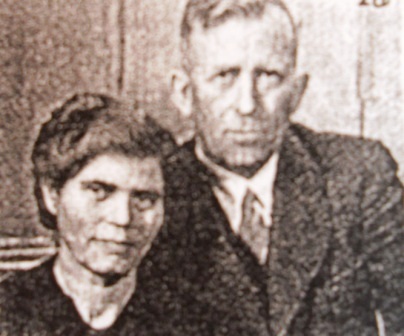 |
| Johan and Wilhemina Glaudemans, after the war |
In the first year at the camp, he tells a story of smuggling messages out of the camp, using a local native, and of learning that his wife and children were safe, in a so-called protection camp for women and children, a camp that was subsequently closed; the children were taken away from their mothers, and the women being incarcerated in a regular prison camp. In a sidenote, Wim points out that the Japanese considered boys of 11 years and older as men, so they were separated; the respective camps of women and "men" shared a hospital, situated midway between them, and they were able to pass messages occasionally ... at least when the carrying individual survived the hospitalization, which was rare.
From time to time, he would be moved to another camp, and in January 1944, he found himself in the inland camp of Tjikoeda Pateuh, still separated from his wife and children. In that camp, he joined nearly 10,000 other prisoners, with one water tap for every 450 men. Here, he goes into some detail: "In the morning we got a plate of porridge made of some tasteless kind of starch, with no nutritional value. For lunch we got 6 ounces of boiled rice with watery soup, and in the evening a small piece of bread. There was never any meat, vegetables, butter, fruit, or salt, which you need in tropical countries." Things continued to go from bad to worse, as the Japanese began an apparently-deliberate strategy of slow starvation. As my uncle Wim points out, when the war ended, there were some 20,000 tons of rice in local warehouses. The camp was full of disease and death; an average of 7 men died each day, dysentery and edema was everywhere, teeth were loosening and falling out, and by the end of the war my grandfather weighed just 110 pounds.
At the camp, he was asked to serve as a barracks leader, a request Johan did not especially appreciate but accepted nonetheless. In his words "it was not a nice job. It was mainly clearing up and cleaning up the places and belongings of the the people who had to be sent to the contagious disease barracks or those who died."
The war ended with the dropping of the atomic bombs on Hiroshima and Nagasaki, an event the local Japanese refused to acknowledge until the 19th ofAugust, 1945. As befits a Dutch mariner, who, as the saying might go, maybe wrong but is never in doubt, my grandfather was characteristically unambiguous in his support for President Truman's decision: "The Americans did the right thing, and I am still grateful. By dropping them they surely saved a lot of lives of prisoners in the Netherlands East Indies, Burma, Thailand, and the Philippines, not to forget the American, British and Australian soldiers still fighting in the Far East. We should never forget that."
Years later, I would marry a woman, Jennifer, whose father served in the US Marine Corps, deployed throughout the South Pacific during the war. Quite apart from the miracle of surviving numerous beach landings and firefights, Glenn Martin was poised as part of the planned Japanese invasion force when the bombs dropped. It's sobering to reflect on the fact that both Jennifer and I are alive ... as are our children -- in no small part a result of the timely end of the war in the Pacific.
Once the war ended, chaos prevailed for a period of months, as camps fell into uncertain leadership, governments and bureaucracies struggled with the realities of tens of thousands of displaced families, and the Netherlands sought to re-establish control over its faraway colony, a land that would become Indonesia. The Japanese had spent the war years fueling the independence movement that had already emerged, pre-war, in Indonesia, and the movement quickly blossomed, placing the Dutch on the defensive, leading to continued hostilities ... this time between the Dutch and the local Indonesians.
On August 27, 1945, Johan received his first bit of news from his family: his wife and children were alive. On September 5, his eldest son, Piet, appeared before him. In his understated way, Johan writes simply that "it was quite a reunion." The next day, the other two boys appeared, having walked and lorried their way to their father'scamp. There, Johan learned of Wim surviving attacks of appendicitis and peritonitis in the camp, and, soon, learned that his wife had been severely ill with dysentery and could no longer walk because of the resulting edema, and remained hospitalized.
In September 1945, Johan was finally able to write to his father in Holland about his experiences, a letter that is included in his memoirs. At the time, he did not know that his father had died on February 18, 1945, just before the liberation of the Netherlands from the German invaders. In his letter, written just a month after the end of the war, his feelings about his captors are revealed when he exclaims that "everyone should know what these bastards have done ... people died like rats." In fact, the author James Clavell's first novel was titled King Rat, a barely-fictionalized account of a similar WWII Japanese POW camp in Singapore.
 | |
| Piet, Neil, Wim, Johan, and Wilhemina Glaudemans, post-war |
As a result of the independence movement's growing hostility to the recently released Dutch prisoners, life outside of the camps became as or more dangerous than life inside the camps; abductions and murders of Europeans were commonplace. Train travel was suspended as a result of insurgent attacks, so it became impossible for Johan to reach his wife, despite her steadily worsening condition. Finally, he left the three boys with a military officer, who promised to try and get the boys to their mother's hospital, and he hopped on a Japanese (!) plane to Batavia, where he was driven by military truck under armed escort to a local camp, from where he took a bicycle to his wife's hospital. He arrived on October 4, 1945, having been separated for three years and three months. She had lost a lot of weight, suffering extreme edema, but, in his words, "her spirit was unbroken."
Continued political unrest and violence led to the now-Dutch-managed camps being attacked regularly by Indonesians ... as if the Japanese-driven privations weren't enough, the Dutch now faced daily attacks from the local population. Train travel was prohibited for Europeans, and even the local buses were dangerous. Eventually, the three boys arrived at their mother's side; on October 20, 1945, in what my grandfather describes as the happiest day of his life, "the boys came in and the five of us were together again."
Continued political unrest and violence led to the now-Dutch-managed camps being attacked regularly by Indonesians ... as if the Japanese-driven privations weren't enough, the Dutch now faced daily attacks from the local population. Train travel was prohibited for Europeans, and even the local buses were dangerous. Eventually, the three boys arrived at their mother's side; on October 20, 1945, in what my grandfather describes as the happiest day of his life, "the boys came in and the five of us were together again."
 |
| SMN Flagship "Oranje," fitted as a hospital ship during WWII |
After the reunion, even as political events began to accelerate in Indonesia, the Dutch shipping companies, and my grandfather, resumed their business of shipping supplies to and from the island archipelago. Crew for these ships were in short supply, and my Dad's two older brothers were old enough to join on as crew for the return to Holland on the flagship of my grandfather's shipping company, the"Oranje." The ship returned to Batavia in February 1946 to find Johan's wife in better health, and my father ready to return to Holland in his own right. They arrived in Holland on March 19, 1946, and soon thereafter arrived in the family village of Kerkdriel.
A few months later, my grandfather left Indonesia on April 26, 1946, as second mate on the same ship "Oranje." After 19 years on land, he was back on a ship. After a few hours at the helm, "I had the feeling that my career as a ship's mate had never been interrupted. We sailed straight for Suez, and through the canal to Rotterdam. We arrived at Rotterdam on May 16, 1946, and I was told that I had to stay on board to move the ship the next day. I told the captain to find someone else and left to join the bus to return to my family."
Johan was to return to the East Indies sooner than he could have imagined; in November 1946, he was ordered back to his old port in Batavia, leaving his wife and children behind. There, he was charged with the responsibility of getting the ports operating again, after years of neglect and bombing. He traveled throughout Indonesia seeing to the various ports' reconstruction efforts, navigating the restless and often warring political factions in these nascent days of Indonesia's declared but as yet-unrecognized independence. In a letter sent home in June 1947, he wrote that: "it seems we are a country still at war." Attacks on Dutch businessmen were common, but Johan traveled extensively by plane, ship, and train to address port reconstruction requirements. On January 26, 1949, just before the Dutch and Indonesian governments completed negotiations for the terms of Indonesia's independence, Johan embarked on the now-familiar "Oranje" one last time for his final trip home.
After 44 years of service to the shipping company SMN, my grandfather retired on June 30, 1960, and spent his retirement years consulting globally on port construction and operations, visiting his children and grandchildren. The company's motto, Semper Mare Navigandum (Always sail the seas), conveniently fits the company initials.
After the war, Johan never accepted a ride in a Japanese or German car, preferring instead to walk. His wife, Wilhemina Johanna Glaudemans, but referred to as Mother throughout his memoir, died on January 6,1975, after a steady decline owing to Alzheimer's disease.
Johan Piet Maria Glaudemans died on June 7, 1991 in Bilthoven, Netherlands. His burial card, written by his three children, reads: We are saddened but grateful for everything he did for us. He possessed an unassailable integrity and sense of duty. ... He always championed the cause of those entrusted to his care, even under the most trying of circumstances, such as occurred in the Japanese concentration camps duringWorld War II. "
I never really got to know my grandfather in person; my one visit as an adult came as he struggled with the mental and physical infirmities of old age, but his memoir has given me a strong sense of attachment to a man who set goals, saw them through, and embodied a sense of stoicism in the face of the unexpected. In this, my grandfather's life, as reflected in his memoir, recalls a quote by the Stoic philosopher Seneca, perhaps a tidy summation of a life well lived and a life well worth reflecting upon:
"For what prevents us from saying that the happy life is to have a mind
that is free, lofty, fearless and steadfast - a mind that is placed
beyond the reach of fear, beyond the reach of desire, that counts virtue
the only good, baseness the only evil, and all else but a worthless
mass of things, which come
and go without increasing or diminishing the highest good, and neither subtract any part from the happy life nor add any part to it?
A man thus grounded must, whether he wills or not, necessarily be attended by constant cheerfulness and a joy that is deep and issues from deep within, since he finds delight in his own resources, and desires no joys greater than his inner joys. "
Monday, August 22, 2011
Scatter 44
 |
| Jon, at the desk at Karang Divers |
Getting here was more of a challenge than I expected; the currents that run southward between the island of Bali and the tiny, mid-channel island of Lembongan are extreme, and on the morning of my departure, I found myself with both engines running full ahead -- at RPMs that normally push me along at 7 knots -- and watching the chart plotter show my boat moving backwards at the speed of 1.5 knots! For the mathematically-challenged readers, this translates to a current of about 8.5 knots -- or roughly 9.3 miles per hour! It takes a long time to get somewhere when you're moving backward, so I hung a sharp right, headed south with the current, and slid across the current eastward toward the coast of Lembongan, where the current slowed to a mere 4 knots -- allowing me to head northeastward to the tiny harbor at the glacial pace of 3 knots ... arriving in late afternoon, having spent 10 hours traveling 20 miles at full engine speed. Without current, it's a 3 hour trip.
(Later, the very same currents would claim the life of a diver off Lembongan; here, currents don't just flow along the surface, they also move water up and down, as shoreside water is propelled to the 1000 foot depths of the mid channel, and then up again to the beaches of the adjoining shore. The diving tragedy began in Lembongan; the diver was apparently carried to 700 feet by the current, and the body washed up on the distant shore of Bali the next day. Even before the tragedy, the dive shops on Gili Air, one of which is owned by my friend Cedric and run by my friend Stannie, remain especially vigilant to currents, again reminded of the invisible power of the ocean. My prayers are with the diver and the family.)
Arriving at Gili Air, and re-introducing myself to Cedric and Stannie, I learned that their Gili Air dive shop was short of staff for a week or so -- Cedric had a three-day snorkeling trip to run for customers, Stannie was hosting a friend from Holland on Lembongan (she was there the day of the afore-mentioned accident), and others in the dive shop had diving commitments ... I offered to help, and just like that, gained another entry for my CV: interim manager of a dive shop. This is my story.
 |
| Cedric, Stannie, and Jon |
In the first, I remembered one of my favorite records -- the Bill Cosby comedy album relating the story of playing football on the streets of Philadelphia: Arnie, go down, uh, 10 steps, and cut left behind the black Chevy. Philbert, you run down to my house, and wait in the living room. Cosby, you go down to Third Street, catch the J bus. Have him open the doors at 19th street. I'll fake it to you."
In the second, my Indonesian-born, European-raised father, who understood football but lacked any childhood muscle memories to throw a football any distance, would gather his six boys for a game of street football, and utter the deceptively-simple words "Scatter 44 " when describing the passing routes we were to run. In Glaudemans-speak, we knew what it meant: everyone was on their own, just run down the street, and somehow, someone would be thrown a wobbly pass.
On Gili Air, my new dive shop -- I was feeling immediately proprietary -- turns out to be a recent outgrowth of a much-more established shop on the neighboring Gili Trawangan (T), and as such, is dependent on the older shop's air compressor. Since full airtanks are a prerequisite for a safe dive, this means that any dives that use Gili Air as a launching point need tanks that are filled on the other island -- necessitating a constant shuttling of empty tanks to and full tanks from the mother shop.
We keep a modest base of dive equipment on Gili Air -- regulators, BCDs, wetsuits, fins, etc., but, as I was soon to learn, not everyone comes in the predicted sizes ... again requiring carefully planned requisitions from the mother shop for outsized fins, the odd BCD, etc. Further, certain dives could be chaperoned by a dive master; others required the services of a certified instructor, each of which paid on a commission basis, working freelance ... when they chose to work.
Finally, we need to make sure we have a boat, a captain and fuel for each dive trip ... with said boat, captain, and fuel based on yet another adjoining island -- Lombok. Three islands, tanks, fuel, instructors, divemasters, BCDs, fins, regulators, wetsuits, boat captains ... and matching these against our customers' vacation hours.
Each day, the various elements of the dive shop leave the shop, disappear around the island, wind up in someone's living room, or take the Third Street J bus and end up on 19th street. Once they returned in the afternoon, I would hear the moral equivalent of a Scatter 44 command, and everyone and everything would run out the door of the dive shop to God knows where to spend the night ... boats to Lombok, instructors to the bars on Gili Air, tanks back to Gili T for filling, etc..
Each night felt like the night before D-Day -- orchestrating the following day's boat movements, staff assignments, and equipment placements -- leave Lombok, pick up fuel in Mentigi, run to Gili T to pick up tanks, come to Gili Air for the client, make sure the instructor was here on time, trade a large BCD for a medium, drop off tanks at Gili T after the dive to be re-filled, refuel the boat, return to Gili Air for more customers, etc.
Add to the mix the fact that Ramadan had started, and that local employees were fasting during the day and eager to return to their families in the evening, and the commission-based payment structure for divemasters and instructors -- leading to them being less-than-enthusiastic at trips that involved just a few customers .... was a challenge to say the least.
By the third day, it became unsustainable; two of our divemasters were leaving that day for a 7-day diving trip to Komodo; one instructor continued to nurse a serious ear infection; a part-time helper was set to disappear to Java to continue her travels, and the mother shop needed all of our equipment to deal with their high-season demand. We had no flex on either equipment or staff.
Thus, at the suggestion of the owner, I closed the dive shop for a few days. The ultimate headfake. The ultimate Scatter 44. And the ultimate CV entry: "Interim Dive Shop Manager -- August 14-18, 2011. Responsible for overall operations; dynamic leadership resulted in having to close down the shop due to excessive managerial complexity and insufficient staff."
References available upon request.
Saturday, August 20, 2011
Mother Daughter
 |
| Virginia Morris Martin, 1928-2011 |
 |
| Kate, using her late grandfather's walker |
Being away from family is the hardest part of this trip; we can easily weather the occasional storm, the broken watermaker, the heat and humidity; they do not touch our hearts and souls, nor do they leave the lingering sense of helplessness and, yes, selfishness, as I sit on a sunny beach reflecting on my mother-in-law's selfless life, and worrying about my daughter, my niece, my family. God bless them all.
Monday, August 8, 2011
Sanur, A Small Taste of Bali
Jon and I spent just over a week in Bali, with most of that time devoted to getting the boat ready for our Indian Ocean passage. We did, however, take a day off and spent it in the small town of Sanur on the southeast coast of the island. Most of the tourist action in Bali takes place on the southern end of the island, and the hardest partying spots, namely Kuta, are on the western side. Sanur, occasionally called "snore" is more sedate, and is the "cardigan Kuta," if you will. It hugs over 4 kilometers of the coast and is home to lots of restaurants, shops and a large ex-pat community.
 We began our day at the the northern end at a place called the Bonsai Cafe. Home to many award winning bonsai trees, the cafe overlooks the beach and offers lessons in bonsai pruning. Here, a young trainee was practicing under the careful eye of a master.
 Hinduism has many gods, major and minor, and they are often represented in statue form near the entrances to buildings and homes. Interestingly, these statues are often clothed....usually a sarong wrapped around their middle. Modesty must be respected, I suppose, even for statues. Tourists' dollars are so attractive, however, that the local population tolerates (for the most part) topless sunbathing on their beaches. I say for the most part, because in some parts of Indonesia, modesty is more strictly enforced, such as in Aceh where sharia law has a strong influence. Hotels where western tourists stay in Bali and Jakarta have also been the target of terrorist bombings by Jamia Islamiya.
 Personally, I find it charming to clothe statues and found these bashful Buddahs prarticularly cute.
 Gates and entrances are also interesting in Bali. They often depict going through a mountain, so that they are thick and tapper upward. Sometimes, just beyond the gate, a wall is centered so that the person entering must turn either right or left to continue. It is believed that evil spirts cannot turn, and thus are deterred from harassing ones' premises.
 As Hindus, Balians practice cremation and Jon and I happened to stumble upon a ceremony occurring on the beach. We learned that the day of the ceremony is determined by not only by when it is convenient for a family and its fiances, but also when it will be a "good" day as detemined by the Balinese calendar. A 4 hour service begins at the temple and then the mourners proceed to the beach where the body is cremated and a small replica of the temple is burned alongside it. The burning process is believed to release the deceased's spirit. The ashes are then put on a boat and taken out to sea. Mourners dress in their traditional sarongs and headbands and much food is served while the cremation takes place. We also saw along the shoreline, poles in the water with bags hanging from the top of them. We were told they contained the ashes of deceased people and were slowly be dispersed to sea. I would like to find one of these Balinese calendars that lets me know which days will be good and which one's will be not so good; it would help know which days would be better spent in bed.
 Our walk along the beach continued to charm us. There are many colorful outriggers to take tourists and locals out on the water. As we saw in Vietnam, the boats have eyes painted onto the bows, which help scare away evil spirits that may be lurking in the water.
 Fishermen are plentiful in these waters. The Indonesians love to wade out to waters about waist or chest high and cast their lines all day and night....they are crazy about fishing. Here they were hats with numbers painted on them to indicate they have the appropriate license. I know fishing is serious business, but I don't think I could do it with a straight face while wearing a helmet that looked like an inverted salad bowl!
 Further down the beach, workers were raking up the washed up sea weed and burying it in the sand....seems like a good idea. Not far from the worker, however, was a dead sea snake that had washed ashore. It was the biggest sea snake we've ever seen; maybe 4-5 feet long. I assure you that if we'd encountered this creature live on one of our dives, I would have panicked even more that if I'd come nose to nose with a shark!
 The mosquito and sand fly are more typical pests one encounters along the beach. But apparently there is a beach in Sanur that is insect free. It wasn't obvious how they kept the critters from encroaching on their non-delineated beach. The back of this sign says, "End of insect free area," so it was in fact a very narrow safe zone......
 More pleasurable was taking a break at a small cafe for coconut water. A truly tropical treat and a great thirst quencher. Jon and I have enjoyed this treat since we were in the Marquesas, but here, the Balinese serve it with lime wedges, sugar water and peanuts.

 Along the southern end of Sanur was a kite park where the locals gathered to fly their long-tailed kites. In the meantime, dozens of human kite surfers were sailing up and down the shoreline, dodging fishermen and fishing boats. It was a lovely day off the boat, and a great taste of the easy life in Bali.
 We began our day at the the northern end at a place called the Bonsai Cafe. Home to many award winning bonsai trees, the cafe overlooks the beach and offers lessons in bonsai pruning. Here, a young trainee was practicing under the careful eye of a master.
Of all the thousands of islands in Indonesia, Bali is unique. It is the home to a form of Hinduism that is practiced only here. The music is an ethereal rhythm of flute and bells and, if listened to intensely, can easily put one into a trance. I liked it and found it relaxing, but only if I heard it as background noise and did not concentrate on it directly.
 Hinduism has many gods, major and minor, and they are often represented in statue form near the entrances to buildings and homes. Interestingly, these statues are often clothed....usually a sarong wrapped around their middle. Modesty must be respected, I suppose, even for statues. Tourists' dollars are so attractive, however, that the local population tolerates (for the most part) topless sunbathing on their beaches. I say for the most part, because in some parts of Indonesia, modesty is more strictly enforced, such as in Aceh where sharia law has a strong influence. Hotels where western tourists stay in Bali and Jakarta have also been the target of terrorist bombings by Jamia Islamiya.
 Personally, I find it charming to clothe statues and found these bashful Buddahs prarticularly cute.
 Gates and entrances are also interesting in Bali. They often depict going through a mountain, so that they are thick and tapper upward. Sometimes, just beyond the gate, a wall is centered so that the person entering must turn either right or left to continue. It is believed that evil spirts cannot turn, and thus are deterred from harassing ones' premises.
 As Hindus, Balians practice cremation and Jon and I happened to stumble upon a ceremony occurring on the beach. We learned that the day of the ceremony is determined by not only by when it is convenient for a family and its fiances, but also when it will be a "good" day as detemined by the Balinese calendar. A 4 hour service begins at the temple and then the mourners proceed to the beach where the body is cremated and a small replica of the temple is burned alongside it. The burning process is believed to release the deceased's spirit. The ashes are then put on a boat and taken out to sea. Mourners dress in their traditional sarongs and headbands and much food is served while the cremation takes place. We also saw along the shoreline, poles in the water with bags hanging from the top of them. We were told they contained the ashes of deceased people and were slowly be dispersed to sea. I would like to find one of these Balinese calendars that lets me know which days will be good and which one's will be not so good; it would help know which days would be better spent in bed.
 Our walk along the beach continued to charm us. There are many colorful outriggers to take tourists and locals out on the water. As we saw in Vietnam, the boats have eyes painted onto the bows, which help scare away evil spirits that may be lurking in the water.
 Fishermen are plentiful in these waters. The Indonesians love to wade out to waters about waist or chest high and cast their lines all day and night....they are crazy about fishing. Here they were hats with numbers painted on them to indicate they have the appropriate license. I know fishing is serious business, but I don't think I could do it with a straight face while wearing a helmet that looked like an inverted salad bowl!
 Further down the beach, workers were raking up the washed up sea weed and burying it in the sand....seems like a good idea. Not far from the worker, however, was a dead sea snake that had washed ashore. It was the biggest sea snake we've ever seen; maybe 4-5 feet long. I assure you that if we'd encountered this creature live on one of our dives, I would have panicked even more that if I'd come nose to nose with a shark!
 The mosquito and sand fly are more typical pests one encounters along the beach. But apparently there is a beach in Sanur that is insect free. It wasn't obvious how they kept the critters from encroaching on their non-delineated beach. The back of this sign says, "End of insect free area," so it was in fact a very narrow safe zone......
 More pleasurable was taking a break at a small cafe for coconut water. A truly tropical treat and a great thirst quencher. Jon and I have enjoyed this treat since we were in the Marquesas, but here, the Balinese serve it with lime wedges, sugar water and peanuts.

Kite flying is an Indonesian passion. For some, the kites are used to whisper messages to the gods, such as a good rice harvest would be appreciated. For others, they are an intense hobby and the kites come in many shapes, colors and sizes. Some even have noise makers, which can create eerie un-decernible sounds that float on the winds. Here in Sanur, we saw these kites in the shape of sail boats.
 Along the southern end of Sanur was a kite park where the locals gathered to fly their long-tailed kites. In the meantime, dozens of human kite surfers were sailing up and down the shoreline, dodging fishermen and fishing boats. It was a lovely day off the boat, and a great taste of the easy life in Bali.
Friday, August 5, 2011
Mother Sister Daughter
One of the things we more or less anticipated when we left on our circumnavigation was that our families’ lives back home – parents, siblings, children – would continue to unfold without regard to our absence. We knew we’d miss birthdays, anniversaries, holiday reunions, a birth, graduations, and as sure as the pages on a calendar turn, they have come and gone as we’ve sailed our way westward. I think we knew in our heads that our immediate and extended family members would also experience the unexpected…the marriage proposal, the new job, a college acceptance, and, in the back of our minds, we understood that some of our family members would also experience the other side of surprise: a sudden illness or injury, a loss, a profound disappointment. As our trip has unfolded, we've found that missing the "good" events has brought pangs of regret but no lasting sorrow. Not so with the "bad" events -- not being present for our kids, our siblings, our parents has proven to be far more difficult than we imagined. In some sense, we've been lucky because for the most significant episodes, we've been able to suspend our trip and have one of us -- Jennifer -- return home. Early in our trip, we encountered our first episode as we sailed the boat down the east coast of the US (when a three-day trip seemed to demand lots of planning and forethought!): our daughter had an accident requiring surgery. Then, it was no big deal for one of us to fly to Denver to be with her.
Later, as we sailed to the Galapagos, Kate again needed surgery; this time, it was a bigger decision for us, given the distance, but again, logistics were such that one of us could fly back and be with her. As we sail further and further west, into more remote areas of the planet, our extended families’ unexpected and unwanted medical issues continue to emerge – to be sure, no more or less frequently than any other large family – I have 5 brothers and my father; Jennifer has a sister and two brothers and her mother; together we have 16 nephews and nieces. With the internet permitting regular and relatively reliable access to our families’ lives, we find ourselves continuing to feel a homeward tug whenever we hear about someone facing a serious medical condition … feeling perhaps that if one or both of were physically present, then somehow that family member’s prognosis or experience would somehow be improved.
We all benefit from the presence of family during difficult times, so it’s hard for us to sleep peacefully on a well-equipped yacht in a beautiful harbor when we know someone we love is in pain or distress. While Jennifer and I like to joke that she’s covered with emotional Velcro, and I’m coated with emotional Telfon, the characterization hits home uncomfortably when such news comes across our emails or Skype phone calls. I take note of the unhappy news, and respond, if you will, logically – what can we do to help, etc. Jennifer feels the pain or distress personally, as if it’s happening to her.
Recently, and each for different reasons, news from Jennifer’s mother, sister, and daughter has arrived to tug at her and our heartstrings from half a world away. Can there be a more important troika than a mother, a sister, and a daughter? In particular, her mother, after a long life of loving motherhood and caring service as a school diagnostician, has become increasingly frail with the years, and this week took a sudden turn for the worse. The size of our family assures that there is a significant and responsive local support network to anyone in need, and this makes it less difficult for us to absorb these surprises, and it was clear to Jennifer’s head that each of three women was in good hands, relying on varying combinations of inner strength, family support, and friends and colleagues. But Jennifer’s heart was another story.
As a sailing couple, in the intimacy of a small boat, it’s impossible to hide one’s feelings from the other, so any untoward news from home hits us hard, even if one of us is Teflon-like in his overt response. It becomes hard for us to concentrate on the boat chores, or planning the next adventure when, rationally or not, we feel like we belong with one of our parents, our siblings, or our kids. Jennifer and I spent an evening talking it through, against our previous plans to leave Bali in a few days for South Africa, and once we determined that the requisite visa and cruising permits could be modified, it was an easy decision for Jennifer to book her travel. While news of her mother’s turn for the worse was the driving event for our decision for Jennifer to return home, we’d have to say that the earlier news from her sister, and the fact that our daughter, Kate, is again undergoing major surgery – again the result of her inherited genetic condition – also contributed to the conversation.
Thus, in response to a near perfect storm of these ups and downs, Jennifer is en route to the States, halfway around the world from the boat’s location in Bali Indonesia. It’ll take her three flights and 36 hours to travel to Austin, Texas from here, via Taipei and Los Angeles, where her motherand sister live.
We are blessed to live in a world of airplanes, and to have the logistical and financial where withal to have it both ways – to maintain a cruising lifestyle, but, when our far-away family circumstances take an unexpected turn for the worse, to be there with them … as much for our own sakes as for the sake of our family members. Because, it seems to me at least, facing these issues from a faraway boat, that care-giving and care-receiving each brings its own blessing, and its own relief. Jennifer needs to be with them, for her sake, perhaps as much as any or all of them need her comforting presence. Our trip will be delayed a bit, but our voyage will be more complete somehow for these returns to family and home, containing, as it will, a swirling mix of local adventure, faraway surprises, and a blend of physical and emotional connectedness with our families.
So in a few days, Jennifer will be with the three women that matter the most to her: her mother, her sister, and her daughter, the four of them forming a perfect union of souls. As unfortunate are the circumstances of this re-union, to this husband, son-in-law, brother-in-law, and father, I feel as if each of them will be exactly where they should be – together with each other, in Austin, Texas. For the duration of Jennifer’s visit home, our boat will bob quietly at anchor; the moon will continue to wax; the trade winds continue to blow, and the Indian Ocean will just have to wait its turn to take its toll on our tiny vessel.
I’m learning that voyages are more than just the sum of passages; they encompass journeys of the heart and soul as well, and, in Jennifer’s and my case, a deepening melding of our lives. Writing this as her plane passes overhead, my thoughts and prayers go out to my wife, and to her mother, her sister, and our daughter, as they come together under a blue Texas sky.
Subscribe to:
Posts (Atom)

