Friday, August 26, 2011

My Grandfather, Part Two

It seems like a long time ago that we entered Indonesian waters, marked in part by a posting on my grandfather's choice of the sea as his calling, his posting to Indonesia,and his subsequent internment in a Japanese concentration camp. We expect to leave Indonesia in the beginning of September, and, as promised, here's the second part of two on my grandfather's life, this time beginning with his internment and covering the war years and his post-war adventures. As I mentioned, I am the proverbial son of a son of a sailor, and feel deeply influenced by and indebted to both my grandfather and my father for giving me the gift of a passion for the sea.


When we left the story, on June 25, 1942, my grandfather had just been spirited away by the Japanese to an internment camp in Batavia/Java, with two of his three children frantically bicycling behind the truck carrying him away, trying to keep up so they could report back to their mother where their father had been taken.

In his memoirs, gracefully translated by his son and my uncle Wim, he relates the initial conditions upon being taken prisoner:

"Once we arrived in the ADEK camp, I noticed that there were already hundreds and hundreds of men. We had to find a place ourselves and everybody was allocated about a 4 foot by 4 footspace (!). I lived in a room of 12 by 11 feet with seven people for about five months."

The camps were crowded -- after the initial period, he was housed in a shed with 120 others, sleeping on mats, with limited food and non-existent sanitation. The Japanese would shut the water off during the day, and the toilets could not be flushed. Fruit and vegetables were out of the question. Lice became a regular plague, and the Japanese confiscated all the shaving gear, a real hardship in the humid, tropical environment. Without an adequate diet, eyesight among the older prisoners began to deteriorate, and my grandfather, who spoke several languages, began to read to other prisoners, preferring French. Everyone was given a POW number --1488, Camp CQ-1, for my grandfather.
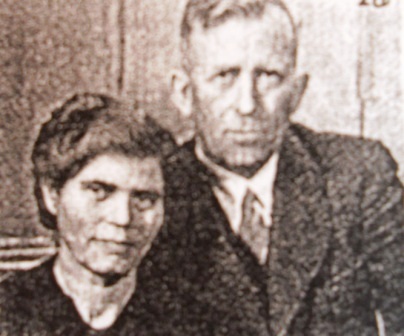
Johan and Wilhemina Glaudemans, after the war

In the first year at the camp, he tells a story of smuggling messages out of the camp, using a local native, and of learning that his wife and children were safe, in a so-called protection camp for women and children, a camp that was subsequently closed; the children were taken away from their mothers, and the women being incarcerated in a regular prison camp. In a sidenote, Wim points out that the Japanese considered boys of 11 years and older as men, so they were separated; the respective camps of women and "men" shared a hospital, situated midway between them, and they were able to pass messages occasionally ... at least when the carrying individual survived the hospitalization, which was rare.

From time to time, he would be moved to another camp, and in January 1944, he found himself in the inland camp of Tjikoeda Pateuh, still separated from his wife and children. In that camp, he joined nearly 10,000 other prisoners, with one water tap for every 450 men. Here, he goes into some detail: "In the morning we got a plate of porridge made of some tasteless kind of starch, with no nutritional value. For lunch we got 6 ounces of boiled rice with watery soup, and in the evening a small piece of bread. There was never any meat, vegetables, butter, fruit, or salt, which you need in tropical countries." Things continued to go from bad to worse, as the Japanese began an apparently-deliberate strategy of slow starvation. As my uncle Wim points out, when the war ended, there were some 20,000 tons of rice in local warehouses. The camp was full of disease and death; an average of 7 men died each day, dysentery and edema was everywhere, teeth were loosening and falling out, and by the end of the war my grandfather weighed just 110 pounds.

At the camp, he was asked to serve as a barracks leader, a request Johan did not especially appreciate but accepted nonetheless. In his words "it was not a nice job. It was mainly clearing up and cleaning up the places and belongings of the the people who had to be sent to the contagious disease barracks or those who died."

The war ended with the dropping of the atomic bombs on Hiroshima and Nagasaki, an event the local Japanese refused to acknowledge until the 19th ofAugust, 1945. As befits a Dutch mariner, who, as the saying might go, maybe wrong but is never in doubt, my grandfather was characteristically unambiguous in his support for President Truman's decision: "The Americans did the right thing, and I am still grateful. By dropping them they surely saved a lot of lives of prisoners in the Netherlands East Indies, Burma, Thailand, and the Philippines, not to forget the American, British and Australian soldiers still fighting in the Far East. We should never forget that."

Years later, I would marry a woman, Jennifer, whose father served in the US Marine Corps, deployed throughout the South Pacific during the war. Quite apart from the miracle of surviving numerous beach landings and firefights, Glenn Martin was poised as part of the planned Japanese invasion force when the bombs dropped. It's sobering to reflect on the fact that both Jennifer and I are alive ... as are our children -- in no small part a result of the timely end of the war in the Pacific.

Once the war ended, chaos prevailed for a period of months, as camps fell into uncertain leadership, governments and bureaucracies struggled with the realities of tens of thousands of displaced families, and the Netherlands sought to re-establish control over its faraway colony, a land that would become Indonesia. The Japanese had spent the war years fueling the independence movement that had already emerged, pre-war, in Indonesia, and the movement quickly blossomed, placing the Dutch on the defensive, leading to continued hostilities ... this time between the Dutch and the local Indonesians.

On August 27, 1945, Johan received his first bit of news from his family: his wife and children were alive. On September 5, his eldest son, Piet, appeared before him. In his understated way, Johan writes simply that "it was quite a reunion." The next day, the other two boys appeared, having walked and lorried their way to their father'scamp. There, Johan learned of Wim surviving attacks of appendicitis and peritonitis in the camp, and, soon, learned that his wife had been severely ill with dysentery and could no longer walk because of the resulting edema, and remained hospitalized.

In September 1945, Johan was finally able to write to his father in Holland about his experiences, a letter that is included in his memoirs. At the time, he did not know that his father had died on February 18, 1945, just before the liberation of the Netherlands from the German invaders. In his letter, written just a month after the end of the war, his feelings about his captors are revealed when he exclaims that "everyone should know what these bastards have done ... people died like rats." In fact, the author James Clavell's first novel was titled King Rat, a barely-fictionalized account of a similar WWII Japanese POW camp in Singapore.

Piet, Neil, Wim, Johan, and Wilhemina Glaudemans, post-war

As a result of the independence movement's growing hostility to the recently released Dutch prisoners, life outside of the camps became as or more dangerous than life inside the camps; abductions and murders of Europeans were commonplace. Train travel was suspended as a result of insurgent attacks, so it became impossible for Johan to reach his wife, despite her steadily worsening condition. Finally, he left the three boys with a military officer, who promised to try and get the boys to their mother's hospital, and he hopped on a Japanese (!) plane to Batavia, where he was driven by military truck under armed escort to a local camp, from where he took a bicycle to his wife's hospital. He arrived on October 4, 1945, having been separated for three years and three months. She had lost a lot of weight, suffering extreme edema, but, in his words, "her spirit was unbroken."

Continued political unrest and violence led to the now-Dutch-managed camps being attacked regularly by Indonesians ... as if the Japanese-driven privations weren't enough, the Dutch now faced daily attacks from the local population. Train travel was prohibited for Europeans, and even the local buses were dangerous. Eventually, the three boys arrived at their mother's side; on October 20, 1945, in what my grandfather describes as the happiest day of his life, "the boys came in and the five of us were together again."

SMN Flagship "Oranje," fitted as a hospital ship during WWII

After the reunion, even as political events began to accelerate in Indonesia, the Dutch shipping companies, and my grandfather, resumed their business of shipping supplies to and from the island archipelago. Crew for these ships were in short supply, and my Dad's two older brothers were old enough to join on as crew for the return to Holland on the flagship of my grandfather's shipping company, the"Oranje." The ship returned to Batavia in February 1946 to find Johan's wife in better health, and my father ready to return to Holland in his own right. They arrived in Holland on March 19, 1946, and soon thereafter arrived in the family village of Kerkdriel.

A few months later, my grandfather left Indonesia on April 26, 1946, as second mate on the same ship "Oranje." After 19 years on land, he was back on a ship. After a few hours at the helm, "I had the feeling that my career as a ship's mate had never been interrupted. We sailed straight for Suez, and through the canal to Rotterdam. We arrived at Rotterdam on May 16, 1946, and I was told that I had to stay on board to move the ship the next day. I told the captain to find someone else and left to join the bus to return to my family."

Johan was to return to the East Indies sooner than he could have imagined; in November 1946, he was ordered back to his old port in Batavia, leaving his wife and children behind. There, he was charged with the responsibility of getting the ports operating again, after years of neglect and bombing. He traveled throughout Indonesia seeing to the various ports' reconstruction efforts, navigating the restless and often warring political factions in these nascent days of Indonesia's declared but as yet-unrecognized independence. In a letter sent home in June 1947, he wrote that: "it seems we are a country still at war." Attacks on Dutch businessmen were common, but Johan traveled extensively by plane, ship, and train to address port reconstruction requirements. On January 26, 1949, just before the Dutch and Indonesian governments completed negotiations for the terms of Indonesia's independence, Johan embarked on the now-familiar "Oranje" one last time for his final trip home.

After 44 years of service to the shipping company SMN, my grandfather retired on June 30, 1960, and spent his retirement years consulting globally on port construction and operations, visiting his children and grandchildren. The company's motto, Semper Mare Navigandum (Always sail the seas), conveniently fits the company initials.

After the war, Johan never accepted a ride in a Japanese or German car, preferring instead to walk. His wife, Wilhemina Johanna Glaudemans, but referred to as Mother throughout his memoir, died on January 6,1975, after a steady decline owing to Alzheimer's disease.

Johan Piet Maria Glaudemans died on June 7, 1991 in Bilthoven, Netherlands. His burial card, written by his three children, reads: We are saddened but grateful for everything he did for us. He possessed an unassailable integrity and sense of duty. ... He always championed the cause of those entrusted to his care, even under the most trying of circumstances, such as occurred in the Japanese concentration camps duringWorld War II. "

I never really got to know my grandfather in person; my one visit as an adult came as he struggled with the mental and physical infirmities of old age, but his memoir has given me a strong sense of attachment to a man who set goals, saw them through, and embodied a sense of stoicism in the face of the unexpected.  In this, my grandfather's life, as reflected in his memoir, recalls a quote by the Stoic philosopher Seneca, perhaps a tidy summation of a life well lived and a life well worth reflecting upon:

"For what prevents us from saying that the happy life is to have a mind that is free, lofty, fearless and steadfast - a mind that is placed beyond the reach of fear, beyond the reach of desire, that counts virtue the only good, baseness the only evil, and all else but a worthless mass of things, which come
and go without increasing or diminishing the highest good, and neither subtract any part from the happy life nor add any part to it?

A man thus grounded must, whether he wills or not, necessarily be attended by constant cheerfulness and a joy that is deep and issues from deep within, since he finds delight in his own resources, and desires no joys greater than his inner joys. "

Monday, August 22, 2011

Scatter 44

Jon, at the desk at Karang Divers
I've been whiling away the days in Gili Air, while Jennifer attends to family matters back in the States, matters discussed in previous postings. Careful readers will recall that we visited Gili Air on our way to Bali, and made some friends at the local dive shop, as well as hung around the slightly refined Scallywags, an internet-friendly beachside restaurant on the east side of the tiny island. With three weeks to kill before Jennifer returned to Indonesia, and we resumed our voyage, and the choice lying between the noisy, dirty harbor in Bali or the friends and beaches of Gili Air, it was a no-brainer.

Getting here was more of a challenge than I expected; the currents that run southward between the island of Bali and the tiny, mid-channel island of Lembongan are extreme, and on the morning of my departure, I found myself with both engines running full ahead -- at RPMs that normally push me along at 7 knots -- and watching the chart plotter show my boat moving backwards at the speed of 1.5 knots! For the mathematically-challenged readers, this translates to a current of about 8.5 knots -- or roughly 9.3 miles per hour! It takes a long time to get somewhere when you're moving backward, so I hung a sharp right, headed south with the current, and slid across the current eastward toward the coast of Lembongan, where the current slowed to a mere 4 knots -- allowing me to head northeastward to the tiny harbor at the glacial pace of 3 knots ... arriving in late afternoon, having spent 10 hours traveling 20 miles at full engine speed. Without current, it's a 3 hour trip.

(Later, the very same currents would claim the life of a diver off Lembongan; here, currents don't just flow along the surface, they also move water up and down, as shoreside water is propelled to the 1000 foot depths of the mid channel, and then up again to the beaches of the adjoining shore. The diving tragedy began in Lembongan; the diver was apparently carried to 700 feet by the current, and the body washed up on the distant shore of Bali the next day. Even before the tragedy, the dive shops on Gili Air, one of which is owned by my friend Cedric and run by my friend Stannie, remain especially vigilant to currents, again reminded of the invisible power of the ocean. My prayers are with the diver and the family.)

Arriving at Gili Air, and re-introducing myself to Cedric and Stannie, I learned that their Gili Air dive shop was short of staff for a week or so -- Cedric had a three-day snorkeling trip to run for customers, Stannie was hosting a friend from Holland on Lembongan (she was there the day of the afore-mentioned accident), and others in the dive shop had diving commitments ... I offered to help, and just like that, gained another entry for my CV: interim manager of a dive shop. This is my story.

Cedric, Stannie, and Jon
The first thing I learned in running a dive shop in Indonesia is that the primary challenge is to make sure all of the necessary ingredients of a dive are present and accounted for at the time the clients show up. This is much easier said than done. That first day, I was brought back to my childhood, in the form of two overlapping memories.

In the first, I remembered one of my favorite records -- the Bill Cosby comedy album relating the story of playing football on the streets of Philadelphia: Arnie, go down, uh, 10 steps, and cut left behind the black Chevy. Philbert, you run down to my house, and wait in the living room. Cosby, you go down to Third Street, catch the J bus. Have him open the doors at 19th street. I'll fake it to you."

In the second, my Indonesian-born, European-raised father, who understood football but lacked any childhood muscle memories to throw a football any distance, would gather his six boys for a game of street football, and utter the deceptively-simple words "Scatter 44 " when describing the passing routes we were to run. In Glaudemans-speak, we knew what it meant: everyone was on their own, just run down the street, and somehow, someone would be thrown a wobbly pass.

On Gili Air, my new dive shop -- I was feeling immediately proprietary -- turns out to be a recent outgrowth of a much-more established shop on the neighboring Gili Trawangan (T), and as such, is dependent on the older shop's air compressor. Since full airtanks are a prerequisite for a safe dive, this means that any dives that use Gili Air as a launching point need tanks that are filled on the other island -- necessitating a constant shuttling of empty tanks to and full tanks from the mother shop.

We keep a modest base of dive equipment on Gili Air -- regulators, BCDs, wetsuits, fins, etc., but, as I was soon to learn, not everyone comes in the predicted sizes ... again requiring carefully planned requisitions from the mother shop for outsized fins, the odd BCD, etc. Further, certain dives could be chaperoned by a dive master; others required the services of a certified instructor, each of which paid on a commission basis, working freelance ... when they chose to work.

Finally, we need to make sure we have a boat, a captain and fuel for each dive trip ... with said boat, captain, and fuel based on yet another adjoining island -- Lombok. Three islands, tanks, fuel, instructors, divemasters, BCDs, fins, regulators, wetsuits, boat captains ... and matching these against our customers' vacation hours.

Each day, the various elements of the dive shop leave the shop, disappear around the island, wind up in someone's living room, or take the Third Street J bus and end up on 19th street. Once they returned in the afternoon, I would hear the moral equivalent of a Scatter 44 command, and everyone and everything would run out the door of the dive shop to God knows where to spend the night ... boats to Lombok, instructors to the bars on Gili Air, tanks back to Gili T for filling, etc..

Each night felt like the night before D-Day -- orchestrating the following day's boat movements, staff assignments, and equipment placements -- leave Lombok, pick up fuel in Mentigi, run to Gili T to pick up tanks, come to Gili Air for the client, make sure the instructor was here on time, trade a large BCD for a medium, drop off tanks at Gili T after the dive to be re-filled, refuel the boat, return to Gili Air for more customers, etc.

Add to the mix the fact that Ramadan had started, and that local employees were fasting during the day and eager to return to their families in the evening, and the commission-based payment structure for divemasters and instructors -- leading to them being less-than-enthusiastic at trips that involved just a few customers .... was a challenge to say the least.

By the third day, it became unsustainable; two of our divemasters were leaving that day for a 7-day diving trip to Komodo; one instructor continued to nurse a serious ear infection; a part-time helper was set to disappear to Java to continue her travels, and the mother shop needed all of our equipment to deal with their high-season demand. We had no flex on either equipment or staff.

Thus, at the suggestion of the owner, I closed the dive shop for a few days. The ultimate headfake. The ultimate Scatter 44. And the ultimate CV entry: "Interim Dive Shop Manager -- August 14-18, 2011. Responsible for overall operations; dynamic leadership resulted in having to close down the shop due to excessive managerial complexity and insufficient staff."

References available upon request.

Saturday, August 20, 2011

Mother Daughter

Virginia Morris Martin, 1928-2011
It's Sunday in Indonesia, the day of the week when Jennifer and I make a point of playing our Stained Glass Music mix, a collection of religious bluegrass songs and our effort to retain a sense of structured spirituality while on a boat sailing around the world.  There are songs of birth and death, life and the hereafter, faith and trust, songs that resonate across the years and miles for us.  One of our favorites, and one that I think we each will want played at any after-the-fact celebration of our life is the Carter family classic, Far Side Bank of Jordan.  Listening to the song today brought tears to my eyes as I imagined Jennifer's dad, Glenn Moore Martin, who died a few years ago, waiting patiently, as the song suggests, on the "far side bank of Jordan" for his wife Virginia Morris Martin, who passed away peacefully on August 7, 2011, having had a last chance to see and feel the love of her four children, five of her grandchildren, and her only great-grandchild.  It's a smaller world we live in.

Kate, using her late grandfather's walker
Kate's hip surgery went as well as expected, and yesterday, just a few short days after being with her grandmother, Kate found herself using her late grandfather's walker as she took her first tentative post-surgery steps, with her mother, Jennifer, watching and capturing the moment on film for her dad, me, to see halfway around the world.

Being away from family is the hardest part of this trip; we can easily weather the occasional storm, the broken watermaker, the heat and humidity; they do not touch our hearts and souls, nor do they leave the lingering sense of helplessness and, yes, selfishness, as I sit on a sunny beach reflecting on my mother-in-law's selfless life, and worrying about my daughter, my niece, my family.  God bless them all.

Monday, August 8, 2011

Sanur, A Small Taste of Bali

Jon and I spent just over a week in Bali, with most of that time devoted to getting the boat ready for our Indian Ocean passage. We did, however, take a day off and spent it in the small town of Sanur on the southeast coast of the island. Most of the tourist action in Bali takes place on the southern end of the island, and the hardest partying spots, namely Kuta, are on the western side. Sanur, occasionally called "snore" is more sedate, and is the "cardigan Kuta," if you will. It hugs over 4 kilometers of the coast and is home to lots of restaurants, shops and a large ex-pat community.

We began our day at the the northern end at a place called the Bonsai Cafe. Home to many award winning bonsai trees, the cafe overlooks the beach and offers lessons in bonsai pruning. Here, a young trainee was practicing under the careful eye of a master.

Of all the thousands of islands in Indonesia, Bali is unique. It is the home to a form of Hinduism that is practiced only here. The music is an ethereal rhythm of flute and bells and, if listened to intensely, can easily put one into a trance. I liked it and found it relaxing, but only if I heard it as background noise and did not concentrate on it directly.

Hinduism has many gods, major and minor, and they are often represented in statue form near the entrances to buildings and homes. Interestingly, these statues are often clothed....usually a sarong wrapped around their middle. Modesty must be respected, I suppose, even for statues. Tourists' dollars are so attractive, however, that the local population tolerates (for the most part) topless sunbathing on their beaches. I say for the most part, because in some parts of Indonesia, modesty is more strictly enforced, such as in Aceh where sharia law has a strong influence. Hotels where western tourists stay in Bali and Jakarta have also been the target of terrorist bombings by Jamia Islamiya.

Personally, I find it charming to clothe statues and found these bashful Buddahs prarticularly cute.

Gates and entrances are also interesting in Bali. They often depict going through a mountain, so that they are thick and tapper upward. Sometimes, just beyond the gate, a wall is centered so that the person entering must turn either right or left to continue. It is believed that evil spirts cannot turn, and thus are deterred from harassing ones' premises.


As Hindus, Balians practice cremation and Jon and I happened to stumble upon a ceremony occurring on the beach. We learned that the day of the ceremony is determined by not only by when it is convenient for a family and its fiances, but also when it will be a "good" day as detemined by the Balinese calendar. A 4 hour service begins at the temple and then the mourners proceed to the beach where the body is cremated and a small replica of the temple is burned alongside it. The burning process is believed to release the deceased's spirit. The ashes are then put on a boat and taken out to sea. Mourners dress in their traditional sarongs and headbands and much food is served while the cremation takes place. We also saw along the shoreline, poles in the water with bags hanging from the top of them. We were told they contained the ashes of deceased people and were slowly be dispersed to sea. I would like to find one of these Balinese calendars that lets me know which days will be good and which one's will be not so good; it would help know which days would be better spent in bed.

Our walk along the beach continued to charm us. There are many colorful outriggers to take tourists and locals out on the water. As we saw in Vietnam, the boats have eyes painted onto the bows, which help scare away evil spirits that may be lurking in the water.


Fishermen are plentiful in these waters. The Indonesians love to wade out to waters about waist or chest high and cast their lines all day and night....they are crazy about fishing. Here they were hats with numbers painted on them to indicate they have the appropriate license. I know fishing is serious business, but I don't think I could do it with a straight face while wearing a helmet that looked like an inverted salad bowl!

Further down the beach, workers were raking up the washed up sea weed and burying it in the sand....seems like a good idea. Not far from the worker, however, was a dead sea snake that had washed ashore. It was the biggest sea snake we've ever seen; maybe 4-5 feet long. I assure you that if we'd encountered this creature live on one of our dives, I would have panicked even more that if I'd come nose to nose with a shark!

The mosquito and sand fly are more typical pests one encounters along the beach. But apparently there is a beach in Sanur that is insect free. It wasn't obvious how they kept the critters from encroaching on their non-delineated beach. The back of this sign says, "End of insect free area," so it was in fact a very narrow safe zone......

More pleasurable was taking a break at a small cafe for coconut water. A truly tropical treat and a great thirst quencher. Jon and I have enjoyed this treat since we were in the Marquesas, but here, the Balinese serve it with lime wedges, sugar water and peanuts.


Kite flying is an Indonesian passion. For some, the kites are used to whisper messages to the gods, such as a good rice harvest would be appreciated. For others, they are an intense hobby and the kites come in many shapes, colors and sizes. Some even have noise makers, which can create eerie un-decernible sounds that float on the winds. Here in Sanur, we saw these kites in the shape of sail boats.


Along the southern end of Sanur was a kite park where the locals gathered to fly their long-tailed kites. In the meantime, dozens of human kite surfers were sailing up and down the shoreline, dodging fishermen and fishing boats. It was a lovely day off the boat, and a great taste of the easy life in Bali.

Friday, August 5, 2011

Mother Sister Daughter

One of the things we more or less anticipated when we left on our circumnavigation was that our families’ lives back home – parents, siblings, children – would continue to unfold without regard to our absence. We knew we’d miss birthdays, anniversaries, holiday reunions, a birth, graduations, and as sure as the pages on a calendar turn, they have come and gone as we’ve sailed our way westward. I think we knew in our heads that our immediate and extended family members would also experience the unexpected…the marriage proposal, the new job, a college acceptance, and, in the back of our minds, we understood that some of our family members would also experience the other side of surprise: a sudden illness or injury, a loss, a profound disappointment. As our trip has unfolded, we've found that missing the "good" events has brought pangs of regret but no lasting sorrow. Not so with the "bad" events -- not being present for our kids, our siblings, our parents has proven to be far more difficult than we imagined. In some sense, we've been lucky because for the most significant episodes, we've been able to suspend our trip and have one of us -- Jennifer -- return home. Early in our trip, we encountered our first episode as we sailed the boat down the east coast of the US (when a three-day trip seemed to demand lots of planning and forethought!): our daughter had an accident requiring surgery. Then, it was no big deal for one of us to fly to Denver to be with her.

Later, as we sailed to the Galapagos, Kate again needed surgery; this time, it was a bigger decision for us, given the distance, but again, logistics were such that one of us could fly back and be with her. As we sail further and further west, into more remote areas of the planet, our extended families’ unexpected and unwanted medical issues continue to emerge – to be sure, no more or less frequently than any other large family – I have 5 brothers and my father; Jennifer has a sister and two brothers and her mother; together we have 16 nephews and nieces. With the internet permitting regular and relatively reliable access to our families’ lives, we find ourselves continuing to feel a homeward tug whenever we hear about someone facing a serious medical condition … feeling perhaps that if one or both of were physically present, then somehow that family member’s prognosis or experience would somehow be improved.

We all benefit from the presence of family during difficult times, so it’s hard for us to sleep peacefully on a well-equipped yacht in a beautiful harbor when we know someone we love is in pain or distress. While Jennifer and I like to joke that she’s covered with emotional Velcro, and I’m coated with emotional Telfon, the characterization hits home uncomfortably when such news comes across our emails or Skype phone calls. I take note of the unhappy news, and respond, if you will, logically – what can we do to help, etc. Jennifer feels the pain or distress personally, as if it’s happening to her.

Recently, and each for different reasons, news from Jennifer’s mother, sister, and daughter has arrived to tug at her and our heartstrings from half a world away. Can there be a more important troika than a mother, a sister, and a daughter? In particular, her mother, after a long life of loving motherhood and caring service as a school diagnostician, has become increasingly frail with the years, and this week took a sudden turn for the worse. The size of our family assures that there is a significant and responsive local support network to anyone in need, and this makes it less difficult for us to absorb these surprises, and it was clear to Jennifer’s head that each of three women was in good hands, relying on varying combinations of inner strength, family support, and friends and colleagues. But Jennifer’s heart was another story.

As a sailing couple, in the intimacy of a small boat, it’s impossible to hide one’s feelings from the other, so any untoward news from home hits us hard, even if one of us is Teflon-like in his overt response. It becomes hard for us to concentrate on the boat chores, or planning the next adventure when, rationally or not, we feel like we belong with one of our parents, our siblings, or our kids. Jennifer and I spent an evening talking it through, against our previous plans to leave Bali in a few days for South Africa, and once we determined that the requisite visa and cruising permits could be modified, it was an easy decision for Jennifer to book her travel. While news of her mother’s turn for the worse was the driving event for our decision for Jennifer to return home, we’d have to say that the earlier news from her sister, and the fact that our daughter, Kate, is again undergoing major surgery – again the result of her inherited genetic condition – also contributed to the conversation.

Thus, in response to a near perfect storm of these ups and downs, Jennifer is en route to the States, halfway around the world from the boat’s location in Bali Indonesia. It’ll take her three flights and 36 hours to travel to Austin, Texas from here, via Taipei and Los Angeles, where her motherand sister live.

We are blessed to live in a world of airplanes, and to have the logistical and financial where withal to have it both ways – to maintain a cruising lifestyle, but, when our far-away family circumstances take an unexpected turn for the worse, to be there with them … as much for our own sakes as for the sake of our family members. Because, it seems to me at least, facing these issues from a faraway boat, that care-giving and care-receiving each brings its own blessing, and its own relief. Jennifer needs to be with them, for her sake, perhaps as much as any or all of them need her comforting presence. Our trip will be delayed a bit, but our voyage will be more complete somehow for these returns to family and home, containing, as it will, a swirling mix of local adventure, faraway surprises, and a blend of physical and emotional connectedness with our families.

So in a few days, Jennifer will be with the three women that matter the most to her: her mother, her sister, and her daughter, the four of them forming a perfect union of souls. As unfortunate are the circumstances of this re-union, to this husband, son-in-law, brother-in-law, and father, I feel as if each of them will be exactly where they should be – together with each other, in Austin, Texas. For the duration of Jennifer’s visit home, our boat will bob quietly at anchor; the moon will continue to wax; the trade winds continue to blow, and the Indian Ocean will just have to wait its turn to take its toll on our tiny vessel.

I’m learning that voyages are more than just the sum of passages; they encompass journeys of the heart and soul as well, and, in Jennifer’s and my case, a deepening melding of our lives. Writing this as her plane passes overhead, my thoughts and prayers go out to my wife, and to her mother, her sister, and our daughter, as they come together under a blue Texas sky.

Saturday, July 30, 2011

Force Field


Doodlebug in the foreground; Bali Marina docks
The Bali Marina occupies a small slice of the industrial waterfront of Benoa, itself situated on the southeast corner of the island of Bali.  The marina is framed by randomly sloping concrete walkways, floating uncertainly along a narrow ship channel used by tugs, small outrigger canoes, outsized yellow catamaran power boats hauling tourists out for dinner cruises, and the occasional sailboat.  The dock lights flicker at night, and boats are cautioned about frequent voltage and amperage drops – so the ramshackle plumbing and wiring systems strung alongside the docks come as no surprise.  Outside the gated walls, the dirt roads are dusty, with the few streets fronted by various one-story government buildings and garage-front stores selling pipe, oil, wiring, and other industrial supplies. There is room for maybe twenty boats or so, and the marina represents the best of shoreside facilities in this part of Bali. 

We made a reservation here several months ago, knowing we’d need reliable access to shore for the inevitable maintenance and repair work after our 2-month trip from Cairns to here, via the Coral, Arafura, Banda, and Flores Seas.  In addition, as unlikely as it seems, boats are safe and secure in this tiny marina, which will allow us to travel inland for a few days to enjoy the well-regarded traditional Balinese artisan communities around Ubud.  We arrived a few days ago, and spent the first day navigating officialdom – surprisingly, clearing into the port was a one-hop stop, and mercifully free of the oft-reported demands for “gratuities” by the officials.  To date, we’ve been fortunate in that regard; most of the cruisers’ reports we’d read about Indonesia complained endlessly about being hit up for extras.  In Ambon, where we checked out during a holiday, we were asked the pay the equivalent of $1.40 in port fees and $15.00 in quarantine inspection fees; in Labuan Bajo, it was $15.00 for port clearance (apparently more than the normal $5), and here it was free.  We paid the government of Australia $330 for the quarantine certificate, so I’m not sure what those cruisers were complaining about. 

Jennifer, Stannie, and Jessica, pre-evening dive
Yesterday was a serious boat work day.  With the lack of winds along the northern coast of Flores and Sumbawa, we found ourselves motoring a lot, and in any event, we want to enter the Indian Ocean with our engines in top shape … so I changed the oil in both engines, changed the transmission oil in each, and changed the impellers used to suck cooling water from the sea into the two engines.  The jobs are messier than they are difficult, but there’s a lot of crawling around, so after six hours of pumping out and re-filling, I was pretty tired.  Jennifer and I are both fighting head colds – karmic revenge for our week of R&R on Gili Air perhaps.

Mandarin fish, +/- 2 inches long
The week on Gili Air ended with a few trips to the adjoining island of Lombok, to a tiny village on the northwest coast, Mengiti, home to Abdul, the erstwhile business partner to Cedric, a 40-year old Frenchman who’s decided to have a go at building a multi-part business venture on the Gili islands.  After co-investing in dive shop on Gili Trawagan, he just opened one up on Gili Air, a few kilometers to the east, run by his Dutch girlfriend, Stanneka, or Stannie for short.  We fell in with Cedric and Stannie, and came to enjoy their company and friendship; together with one of their friends, Jessica, the five of us took ile de Grace over to Mengiti for an evening dive to see the Mandarin Fish … Jennifer and the three of them dove, while I tended the dinghy. 

Jon in Doodlebug, ready to take on the divers
Abdul, Cedric’s Lombok business partner, lives in a small compound just off the beach, with the rest of the village.  Years ago, under the previous government, the Army apparently arrived one day and informed the beach-dwelling village that they all had to move inland a kilometer or so, since the land was now being offered for sale to a friend of the President … the land, with title “properly conveyed,” is still owned by an outsider.  Such is the way of dictatorships; their legacy often “legally” outlasts their tenure.

Today, Cedric and Abdul co-own a small “warung,” or restaurant, with the cook earning a small wage and 60% of the profits.  In addition, Abdul proudly showed me his brick-making business, where his three staff can make about 900 bricks a day.  Each brick sells for 2,500 rupiah (about 27 cents) to the developers on the Gili islands; Abdul’s bricks are valued for their quality; he makes 90 bricks per bag of cement, while his competitors make 125 bricks per bag.  Abdul also serves as a middleman between the various skilled and unskilled laborers of his village and the developers, and, in the area where his services and our needs intersected, manages to procure diesel for boats.  He invited me to his compound, where I met his father and daughter, and where he explained that one of his brothers was working in Saudi Arabia, and the other in Malaysia.  We wish Cedric and Abdul all the luck in the world, and will miss their generous optimism.

Blue ribbon eel, about 1 cm in diameter
After sailing the 45 miles or so west to Bali, it’s clear that the business and culture of Bali is a universe away from Mengiti, with planes flying overhead every hour or so, cars and motorcycles everywhere, and the marina charging 7-10 times the labor rate we had been experiencing in the outer islands.  It’s a big island.  Traffic is everywhere, and the drivers here are a bit unsteady – bobbing and weaving with little regard for traffic lanes, lights, or pedestrians.  We’re learning to watch our step, and yesterday, as Jennifer accompanied Bobby, a fellow cruiser on some errands in his car, she watched with adrenaline-inducing horror as a motorcyclist careened in front of the car without so much as  a glance, with a collision barely avoided.  Bobby, our new friend, exclaimed in tired amazement, “they think they have some kind of f#!%ing Hindu magic force field around them!”

Another wondrous animal of the deep

… which reminds me of another element of this archipelago countries diversity:  religion.  Bali is the country's only Hindu island, and we now see Hindu shrines everywhere, even as we hear pre-dawn calls to Muslim prayer, and see the occasional cross-topped church as we make our rounds.  As I consider our impending 6000+  mile trip southwestward across the Indian Ocean, I find myself leaning to multi-theism as my religion:  perhaps I will fashion a little marigold-laden Hindu offering, bow east towards Mecca, and pray for the Virgin Mary’s intercession … at a minimum, I will want some of that “f#!%ing magic Hindu force field” around our tiny vessel as we cross that great ocean. 

Friday, July 29, 2011

Updated Piracy Guidelines

For those interested, see this link for the most recent guidelines re: piracy in the Gulf of Aden.  Jennifer and I had already decided not to sail these waters, and the guidelines certainly vindicate that choice.

At present, we are in Bali, taking care of boat maintenance, housekeeping, etc., before a few days inland.  From here, we leave in a week or two to Cocos Keeling, an Australian territory, on the way to Mauritius and South Africa.

More postings and pics to follow.

Friday, July 22, 2011

Green


Looking east to Lombok from Gili Air
We’re spending a guilty week on a mooring at Gili Air, the quietest of three small, low coral atolls off the northwest coast of Lombok, the huge island just east of the island of Bali.  In the early morning, the sun profiles the mountains of the West Lombok forest reserve and its several 9-10,000 foot mountains.  In the evening, the setting sun profiles the singular conical volcanic peak of Gunung Agung, rising 10,000 feet over the Bali landscape.  We’re surrounded by a low coral reef, with surf gently breaking, and the soft smoke of wood cooking fires – ubiquitous in these islands – hangs low over the shore line.

Jennifer, preparing for a Gili Air day
I say guilty, because Gili Air, and its two neighboring atolls, are resort islands; we’re on the quiet family-oriented island; the others cater to the younger, partying crowd.  In addition to being a bit more in our age and energy range, there are moorings here, and we’re happy to be on a secure mooring instead of the uncertain anchorages in the other islands' deep, steeply-sloped waters.  Our routine has quickly settled into a dinghy ride ashore in the morning to secure a beach cabana at the locally-run Scallywags bar, breakfast, some internet/email work, and then snorkeling and reading until lunch, followed by more relaxing until we dinghy back to the boat in the afternoon, to rest before going ashore for dinner, eating under our own personal thatch-roofed raised platform with cushions and a low table.

It’s a tough life, but we’re happy to accept the challenge and responsibility of reporting to you, our dear friends, family, and readers, of our closing days in Indonesia.  We leave in a few days for a marina in Bali, where our days will be consumed with a wide array of maintenance activities to prepare our boat for the next legs of our circumnavigation:  the 1,100 mile sail from Bali to the Australian protectorate of Cocos Keeling, the 2,300 mile sail from Cocos to Mauritius, and then the final 1,500 mile leg to Richards Bay, South Africa.  All in all, we’ll be sailing some 4,700 miles in some of the more challenging blue waters on this fair planet.  Our boat needs to be ready, and more importantly, we need to be rested.

Trash-strewn landing beach in Banda
With the free time we’ve given ourselves, I’ve just finished reading the third of three novels – all well recommended and published in 2010.  Each has as its substantive theme the issue of the environment, coupled with a dramatic theme that examines the issue of what a single human being can do to affect the course of environmental history.  As sailors, we are careful to act locally, but in thinking globally, the issues seem daunting.  One of the things that has distressed us about Indonesia is the ostensibly simple issue of garbage disposal:  we see plastic litter everywhere – floating in the ocean, strewn along the high-tide lines, in the streets, etc.  And not just the odd scrap here and there – piles of it.  We bought a few bags of lollypops to give to kids when we went ashore; I watched in  dismay as the kids take the wrappers off and discard them along the unpaved streets and on the beaches.  We see plastic bottles floating miles offshore.  We see trash lying on the bottom of otherwise pristine coral reefs. It’s not just Indonesia; on the windward coast of Margaret Bay, Australia, we saw thousands of bottles strewn along the upper edge of the tidal range.

I understand that certain aspects of environmental awareness are a luxury of developed economies; recycling demands an infrastructure that developing economies are forced to defer in favor of investments in sanitation facilities and clean drinking water.  And I would note that most of America's interstate highways, with their plastic-bottle-laden rest stops, lack recycling facilities.  But the simple act of consolidating garbage -- especially plastics -- seems within reach of every community.  It’s catching in some places in Indonesia – in Bandaneira, we gave some money to a local program designed to teach the kids not to litter – the coloring book highlighted a cultural basis for the throw-away behaviors by reminding people that food was no longer wrapped in banana leaves, and thus the new wrappings – plastic usually – should no longer be discarded on the ground.  But we see a lot of carelessly-strewn trash on the islands of Indonesia.


Wood cooking fires in Wailamung, Flores
The three books – Freedom, by Jonathan Franzen, American Subversive, by David Goodwillie, and Solar, by Ian McEwan – each focus on the struggles of individuals to make sense of their adopted desires to do more than act responsibly in their personal lives, and to somehow make a bigger difference.  While motivations vary across the three sets of protagonists, and the novels are as much about the interpersonal relationships of the protagonists, I think it’s interesting that three of the more well-regarded novels of 2010 deal with the issue of the environment and the dilemma of personally driven change.  It might say something about reviewers’ sensibilities, but I also think it says something about our time:  we’re swamped with stories about global warming and environmental gloom and doom, so we buy hybrid cars and recycle and reduce our carbon footprint, but there’s a sense of futility about these efforts.  Sure, it’s the right thing to do, but it’s a drop in the proverbial bucket.  Australia – whose news we can follow on our ham radio – continues to argue over a carbon tax, while its economy depends almost entirely on exporting coal to China to fuel its economic development. Much of Indonesia – the fourth-most populous nation on earth – relies on wood fires to cook their food. 


Recycling and bicycles in Gili Air
It’s no wonder novelists, who often give voice to the intellectual angst of a time,  are picking up on the frustration.  Jennifer and I will pick up the bottle in the water, and our carbon footprint is as small as can be these days, but we too feel a sense of powerlessness as we watch our oceans rise and its waters become more tangled in the plastic detritus of a consumerist world.  As we begin to allow ourselves to think about re-entering life in America in a year’s time, we’re starting to think about how we might deploy our professional energies; my background is in healthcare, which has its own set of national and global challenges, so I suspect I’ll stay in that realm of the impossible; Jennifer, responding to some of our experiences of our circumnavigation, is considering environmental issues as one option. 

But for now, it’s the guilty pleasures of Gili Air, where, I am pleased to say, they seem to have embraced the new green imperatives – composting, recycling, and a complete lack of cars on the island.  Instead, we have horse-drawn carts and bicycles.  It’s a start.


Gili Air's mass transport system

Thursday, July 21, 2011

Feast and Spices

Here's two short videos of an Indonesian village -- Wailamung -- preparing for a feast, and hands-on demonstration of where a few common spices come from ... enjoy!


Monday, July 18, 2011

Miss and Hit


When we left the mooring at Komodo's Gili Lawa Laut, we intended to sail a short 16 miles to Banta, mentioned in one of the rare cruisers' notes as having a good anchorage and great snorkeling. We've relied on these fragmentary notes to find places to anchor in Indonesia; the shorelines are incredibly steep, and the anchoring systems used by boats rely more on leverage than weight. The steeper the slope, the more likely the dug-in anchor will be yanked out as the tidal current and/or wind swings one way and then another. Picture a steep bowl, and a hook into its side. Pull up to the lip of the bowl (i.e., toward shore), and the hook digs deeper - all good. Pull down to the bottom of the bowl, and the hook slides out. Not good. Thus, we look for places where the underwater profile is at least reasonably sloped - and where the flattened areas do not lie too close to threatening reefs.  With the benefit of hindsight, volcanos thrusting out of the ocean are not great places to look for anchorages.

Despite the glowing remarks in the random cruiser's anchoring notes from 1990 or so (discovered on a random internet site), the bay in Banta seemed to defy gravity - a mere 100 yards from shore, the bottom was impossibly deep - at least several hundred feet. Any closer, the bottom shoaled quickly to a dozen feet or so at high tide. All or nothing. No middle ground ... so we abandoned Plan A, and continued west, sailing overnight along the coast of Sumbawa, the island west of Flores and Komodo, toward other anchorages. At dusk, we passed between the main island and an active volcano jutting some 6000 feet above the water, and, iceberg-like, rising 12,000 feet from the adjoining ocean floor.  Later, we dinghied over and visited the sulfurous lake in the volcano's caldera.

The winds were spotty but the current favorable, so we motored along on one engine through the night, arriving at the tiny central Sumbawa village of Kananga at noon or so the next day. Here, another set of cruisers' notes were spot-on: we found a shelf of dense black volcanic sand lying in just 25 feet of water, just offshore. To the north, across a narrow channel, lies a dormant volcano, its caldera filled with a fresh water lake. As a first order of business when arriving at an Indonesian village, I took our dinghy ashore to introduce ourselves to the village chief.

In this case, we had arrived at the sub-village of Sarae, or sand, the administrative center for Kananga. It was Sunday, a day of rest but of no religious import for this 100% Muslim community. The port office - painted cinderblock - was obvious by its flagpole atop of which flew the red-and white striped Indonesian flag. I was greeted enthusiastically by a T-shirted man and a woman wearing a modest head covering, and was asked to sit down on a bench outside an adjacent building.

A few minutes later, two young women walked up - one with brown hair, round glasses, and a quick smile; the other wearing a traditional Muslim headscarf. In near-perfect American idiomatic English, they introduced themselves, and, quite at ease with themselves, asked how they could help me ... unsure of the scope of their command of English, I patiently and simply explained I was introducing myself to the village, and asking permission to anchor off their beach.

Well, to cut to the quick, there was no need for simple English; the conversational pair of Berly and Shally took me under their wings, introduced me all around, and walked me to the store where I picked up some eggs, coffee, tiny tomatoes, beans, and bean sprouts - all locally grown. As we walked, I learned a bit of their story. They were here as part of Indonesia's version of the Teach for America program (their description). The program - Indonesia Mengajar (Teach Indonesia) - has over 4000 applicants across Indonesia, but only 72 are chosen - with 6-10 sent to a village in each of 9 regions. Given the breadth of Indonesia's islands, running into 2 of them was as lucky as finding a safe place to anchor. Once my land-based chores were done, I invited them and two of their host family friends back to our boat for some tea.

At the boat, I am pleased to note that they loved their Crystal Light drinks, as well as the stack of New Yorkers (for the teachers), and some blank school writing tablets, and pencils we gave them for their students. After a time on the boat, where they asked whether we had Facebook pages, and used their cell phone camera to take pictures of themselves at the wheel of our boat, we were, in turn, invited to join them for lunch at their home. There, we sat in a modest house on stilts, on a 6x9 carpet, and enjoyed a wonderful lunch of rice, stewed spicy vegetables, grilled flying fish, and coffee. Shally had studied to be an architect, and hopes to get into urban planning after completing a master's degree; Beryl studied communication science, and while expressing an interest in a master's program, confessed to having fallen in love with the students, and that she was, perhaps, considering a career in teaching.

We have met many Indonesians in our sailing time here, but to a one, all were either living hand-to-mouth, caring for their families and communities, were local teachers in local schools, or were in the trades. Beryl and Shally were, if you will, the first cosmopolitan Indonesians we met who were overtly aware of the breadth of Indonesia's cultures, lands, and challenges. In their words, their goal is to give students and their families a sense of possibility, centered around education. As an ancillary goal, they saw their role as helping to stitch together the several Indonesia's we've seen: urban and rural; Muslim, Christian, and Hindu; outlying island group to outlying island group.

We wish them well, and hope to see them on Facebook (!) ... we're glad we missed out on the Banta Island anchorage, and we're glad we hit the jackpot here, in Kananga, when we chanced to meet two of Indonesia's brightest hopes for the future ... and, in their students, some future hopes!


Thursday, July 14, 2011

Anniversaries

The summer before we left on our trip, we sailed to a good friend's house on the Eastern Shore for their 40th wedding anniversary. I've known Terry for years, and I crewed on his ocean-capable sloop on his first blue water voyage - to and from Bermuda - and we wouldn't have missed the party even if we didn't have the chance to show off our new boat, ile de Grace! Many of Terry's friends are sailors as well, and as the party took shape, a number of them trickled down to his dock to check out our little catamaran. To a one, the men all seemed to have the same reaction when I talked of our circumnavigation plans: "You are so lucky to be married to someone who sails and shares your dream."

I am lucky. I met Jennifer in August 1981, as we both began our graduate studies at Princeton. A few months later, we sailed my parents' boat, Dutch Courage, and she - and, in turn, I, was hooked. In November of that year, we joined a family friend and sailed his ketch down an ice-cold Chesapeake Bay, ending up in Beaufort, NC a few days and a few groundings later. While there were some fits and starts, we never looked back. We began to live together in the summer of 1982, and have been together ever since.

There are certain parallels between the voyages of marriage and circumnavigation, parallels I'll try not to stretch to the breaking point. In the case, of our marriage, Jennifer and I had a mostly-synchronized vision of a loving, lifelong, committed and caring relationship with children, but neither of us had any real idea of the challenges and choices we'd face along the way. Like any marriage, we've had our ups and downs - times when we were forced to examine our own and each other's hearts and souls, times when we've hurt each other and times when we've needed more of what the other person had a hard time giving. These are the painful truths of any meaningful relationship I think: two strong people, each possessed of the usual complement of strengths and weaknesses, each striving to maintain a sense of self while pursuing the common vision of a mutual commitment to a lifelong union, blessed in a church, before our friends and family.

I am lucky that one of us - Jennifer - is possessed of uncommon doses of patience, foresight, and forgiveness, traits that have kept our marriage on course even when the road got rocky. After 27 years of marriage, and the last 18 months of intimate, unceasing partnership, I see us achieving our shared vision of a lifelong union more clearly than ever.

Deciding to embark on this circumnavigation required an equal leap of faith; I've written about some of the challenges of 24x7x365 proximity, and we've faced some real decision points along the way between suspending our trip or completing what we set out to do. In the end, as in our marriage, Jennifer's steadfastness of purpose, patience, and flexibility have proven to be the critical attributes to our decision to sail south around Africa - postponing her lifelong dream of sailing the Red Sea and the Med - and then home to Maryland.

Trips that take a lifetime, or trips around the world are easy to imagine - even easy to embark upon. Seeing them through is another thing. I'm lucky beyond description to be married to a woman who shares my love of adventure, and possesses the strength of character to help me through the storms and squalls, even -perhaps especially - those of my own making. While we celebrate this anniversary by ourselves, we expect to host our own 40th wedding anniversary in 13 years - July 14, 2024. We hope many of you will be able to join us.

Wednesday, July 13, 2011

Kanawa

Nemofish in the anemone
We've spent the last few days moored off Kanawa Island, a small atoll that lies between the large islands of Flores and Komodo, on the edge of the Komodo National Park. There's a small resort here, using the term loosely: a dozen or so small, rustic bungalows, an open-sided dive "shop," and a slightly larger open-sided, concrete-floored shelter that serves as a combination dining room and reception area. The reef rolls around the southern side of the island, where the resort is situated, and boasts an amazing array of corals, fish, and, at the end of a ramshackle 100-yard pier built on wooden sticks and with planks that have seen better days, a small colony of lionfish.
Lionfish resting in coral
These lionfish are florid creatures, boasting translucent, brown-and-white striped fins jutting our every which way, accented with whiskers and spikes that fill the spaces in between. In water, they hover, twist and turn, and their combination of fins, spikes and body create a ball that can run from a few inches in diameter for the young ones to over a foot in diameter for the adults. An exotic example of the life force in these reefs, where the cold waters of the Indian Ocean mix with the warm waters of the Flores Sea on a twice-daily basis.

The resort is owned by a small consortium of Italian investors, one of whom, Max, lives on the island - he's battling a case of typhoid fever right now, likely picked up in the nearby main town of Labuan Bajo - literally, "boat harbor of the Bajo people," the Bajo being one of the many Indonesian cultures/peoples that migrated around and into these islands. The dive shop was started a few months ago by Ed and Marie, and Englishman and Swede, respectively, who met years ago as they pursued their divemaster certificates, and then, after time in various global diving hotspots, decided to set up a business here on the island.

On their 40' wooden boat powered by two single-piston Chinese diesels, and measuring just a scant 10 feet in beam, we spent two days diving 6 sites in the Komodo National Park. We fell asleep last night delightfully exhausted - and in awe at the sheer variety, quantity, and quality of the reefs in this part of the world. We have dived many sites in our Pacific crossing, but we both agree that none can compare with these.
Komodo's mixture of warm and cool water creates ideal fish/coral conditons
The prototypical Komodo dive is a pinnacle dive - where the boat drops you in the lee of a large rock jutting up from a deep bottom. The tidal currents swirl around these rocks - to the point where, if you aren't careful, you'll be swept out to sea or, worse, down deep - and create a regularly-replenished feeding ground for fish of all sizes, marine animals of all sorts, and hard and soft corals of all types. The other two types - a channel drift dive, and a wall dive - are also common here, but we began our two days of diving on Castle Rock and Crystal Rock. Dropping into the water, we sank into the lee of Castle Rock, a rocky spike that lies awash at low tide. Splayed out in front of us, against the rising column, swam schools of bright yellow and blue fish, thousands turning one way and then the other, in silent synchrony. Swimming through them, with Jennifer at one point nearly invisible in their midst, we faced a wall of hard and soft corals whose diversity brought Darwin's evolutionary theories to mind: nature will try everything once, twice if it works.
Komodo corals
I imagine a King Neptune of old, considering petitions from various coral developers, as they pitched their ideas: "How about a coral that juts 10 meters horizontally from the wall, but less than an inch in diameter, and punctuated with bands of blue?" "Go for it!" ... "How about a mustard-yellow soft coral, patterned on the leaves and stalks of a cauliflower, and swaying gently in the current?" "Why not?!" ... "Can I try out a purple rose concept, with diaphanous leaves that look like tissue paper?" "Have a go!"
Frog Fish
The animal life was equally exotic - at one point we saw a thin worm-like eel, about 1/2" in diameter and about a foot long, with a brilliant blue body tinged with iridescent yellow, swaying in the current, opening and closing its ovaloid mouth, its eyes on two protruding bulbs above its mouth. Neither the divemaster nor we had ever seen anything like it. On another dive, we saw the strange and rare frogfish, a fish that can't swim but instead hops along on prehensile feet; it was wedged against a bit of wall coral, unmoving, unwilling perhaps to let go for fear of falling.

Moray ee
Each dive brought new sights and experiences - the usual run of sharks, large pelagic fish, turtles, anemones, sponges, moray eels, tropical fish in schools that defy enumeration - but at the beginning of one deeper dive, where we ducked under a large overhanging shelf about 70 feet below the surface, Jennifer had a rare find indeed. Tucked into the interstices of a large sea fan, hidden deep against the dark underside of the overhang, our divemaster coaxed a pygmy seahorse into view. Barely bigger than a thumbnail, this tiny sea horse lives in the sea fan itself, using the webbing of the coral to snare enough plankton and the like for its food. Jennifer had mentioned to me a number of times her desire to see a seahorse - here was a rare sub-species, invisible to all but the knowing eye.

We feel lucky to have spent time here, at the Kanawa Island resort, diving with Ed and Marie, and Peter, the Indonesian divemaster who seems to know just where the pygmy seahorses hide. Tomorrow, we have some boat work - time to pay the piper - and then on Thursday, our 27th wedding anniversary, we sail over to Komodo Island and take a guided hike to see the legendary Komodo Dragons. It's mating season, so their attentions are elsewhere, but we still need a guide; there are regular reports of attacks on unwary humans. We'll be careful out there. Nature has a way of surprising you.
Jon and Jennifer -- Diving Komodo Islands